

Real estate agents evaluating video brochures for listing presentations rarely start by asking for a total project budget. Based on actual inquiry emails from brokerage teams and individual agents, the first question is almost always about unit price at a specific quantity:
"Just out of curiosity what is the unit price for 50 brochures."
This pattern — unit price first, then MOQ, then design, then pilot order — is consistent across real estate clients regardless of brokerage size. Understanding why this sequence happens explains how to budget for a listing presentation kit effectively.
In real estate video brochure projects, pricing decisions are not budget-driven. They follow a clear sequence from unit price inquiry to pilot testing before any scale-up decision is made.
Why Real Estate Buyers Are Risk-Driven, Not Price-Driven
The pricing evaluation for video brochures in real estate is not primarily about cost. It is about risk control.
A listing presentation tool only delivers value if it actually changes the outcome of seller meetings. Before committing to a full campaign rollout, agents need to validate whether the format works in real presentations — with real sellers — before spending on volume.
This is why the most common ordering sequence across real estate clients is:
- Unit price inquiry — "what does it cost per unit at 50 pieces?"
- MOQ clarification — "what is my minimum order?"
- Design confirmation — format, artwork, cover type
- Sample or pilot order — 1 to 25 pieces
- Campaign rollout — 50 to 100+ pieces
One brokerage client illustrated this clearly when they asked:
"What is my minimum order for new brochures?"
The question is not about price — it is about the lowest commitment level that still allows them to test the product properly.
Pricing by Screen Size (2026)
The following prices are based on factory-direct production at standard campaign quantities. These cover the configurations most commonly requested by real estate clients.
| Screen Size | Cover Type | MOQ | Typical Price Range (USD) |
|---|---|---|---|
| 4.3" | Soft cover | 25 pcs | $13 – $16 |
| 5" | Soft cover | 25 pcs | $15 – $18 |
| 5" | Hard cover | 25 pcs | $18 – $22 |
| 7" | Soft cover | 25 pcs | $18 – $24 |
| 7" | Hard cover | 25 pcs | $22 – $30 |
Prices include LCD screen, battery, PCB board, speaker, standard CMYK printing, USB cable, and basic packaging.1 Premium finishing — soft-touch lamination, foil stamping, spot UV — is quoted separately.
For a full breakdown across all sizes and configurations, see video brochure pricing guide.
How Quantity Changes the Unit Price
The cost difference between a 25-piece pilot and a 100-piece campaign run is the most significant pricing variable. Setup costs — printing preparation, video loading, assembly, quality control — are largely fixed regardless of volume, which means they are spread across fewer units on smaller orders.
| Quantity | Typical Unit Price (5" soft cover) | Total Budget Estimate |
|---|---|---|
| 25 pcs | $18 – $22 | $450 – $550 |
| 50 pcs | $16 – $19 | $800 – $950 |
| 100 pcs | $14 – $17 | $1,400 – $1,700 |
| 200 pcs | $13 – $15 | $2,600 – $3,000 |
At 50 pieces — the most common entry point for real estate listing presentation campaigns — the unit price typically comes in around $20 for a standard 5" configuration. One brokerage confirmed this was their reference point when starting:
"Just out of curiosity what is the unit price for 50 brochures."
The answer to that question determines whether the project is viable at the pilot stage. Once it clears that threshold, agents move to design and sample confirmation before scaling.2
5-inch vs 7-inch: How Real Estate Clients Choose
Screen size in real estate is not only about budget — it signals how the brochure will be used and what impression it needs to make.
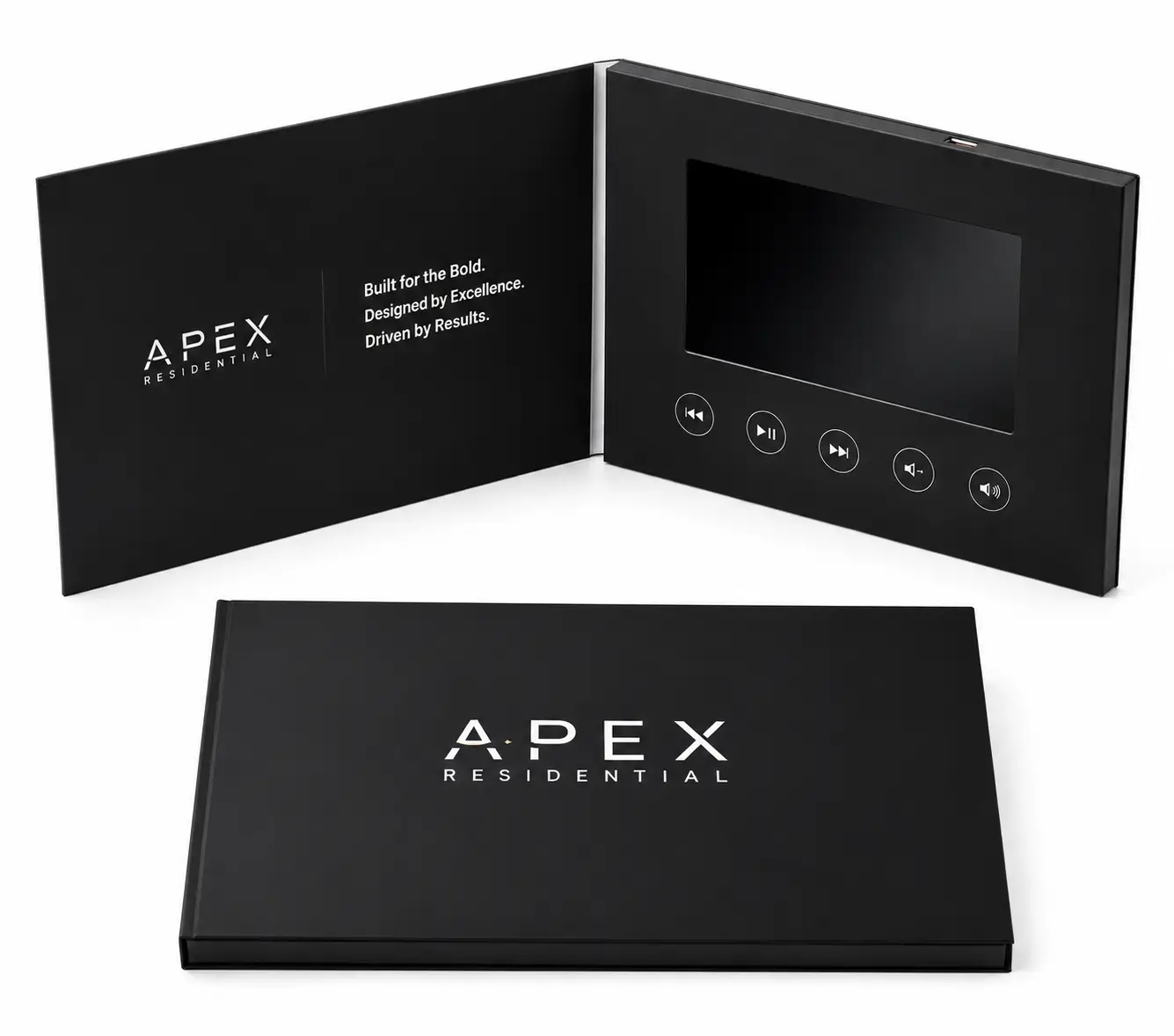
5-inch is the dominant choice for standard listing presentation campaigns. It is compact enough to hand across a desk or leave with a seller after a meeting, and the unit economics at 50–100 pieces make it viable for agents running ongoing campaigns.
7-inch is selected for premium listing presentations and luxury property marketing, where the physical size of the brochure contributes to the impression of the property’s calibre. One high-end brokerage client working on a luxury listing campaign specified their requirements in detail:
"We are looking for it to be a vertical video, long-edge spine that opens like a book with the video on the right-hand side."
This level of configuration specificity — spine orientation, opening direction, video placement — is typical of 7-inch hard-cover projects where the brochure is designed to match the presentation standards of the properties it represents.3
Finishing Options and Their Effect on Budget
Cover finish is where listing presentation kits vary most significantly in perceived quality and cost.
| Finishing Option | Additional Cost (approx.) | Best For |
|---|---|---|
| Standard matte lamination | Included | Standard campaigns |
| Soft-touch lamination | +$0.80 – $1.50/unit | Competitive markets |
| Foil stamping (logo) | +$0.80 – $1.20/unit | Premium listings |
| Spot UV | +$0.60 – $1.00/unit | Luxury positioning |
| Hard cover upgrade | +$3 – $5/unit | Executive-level presentations |
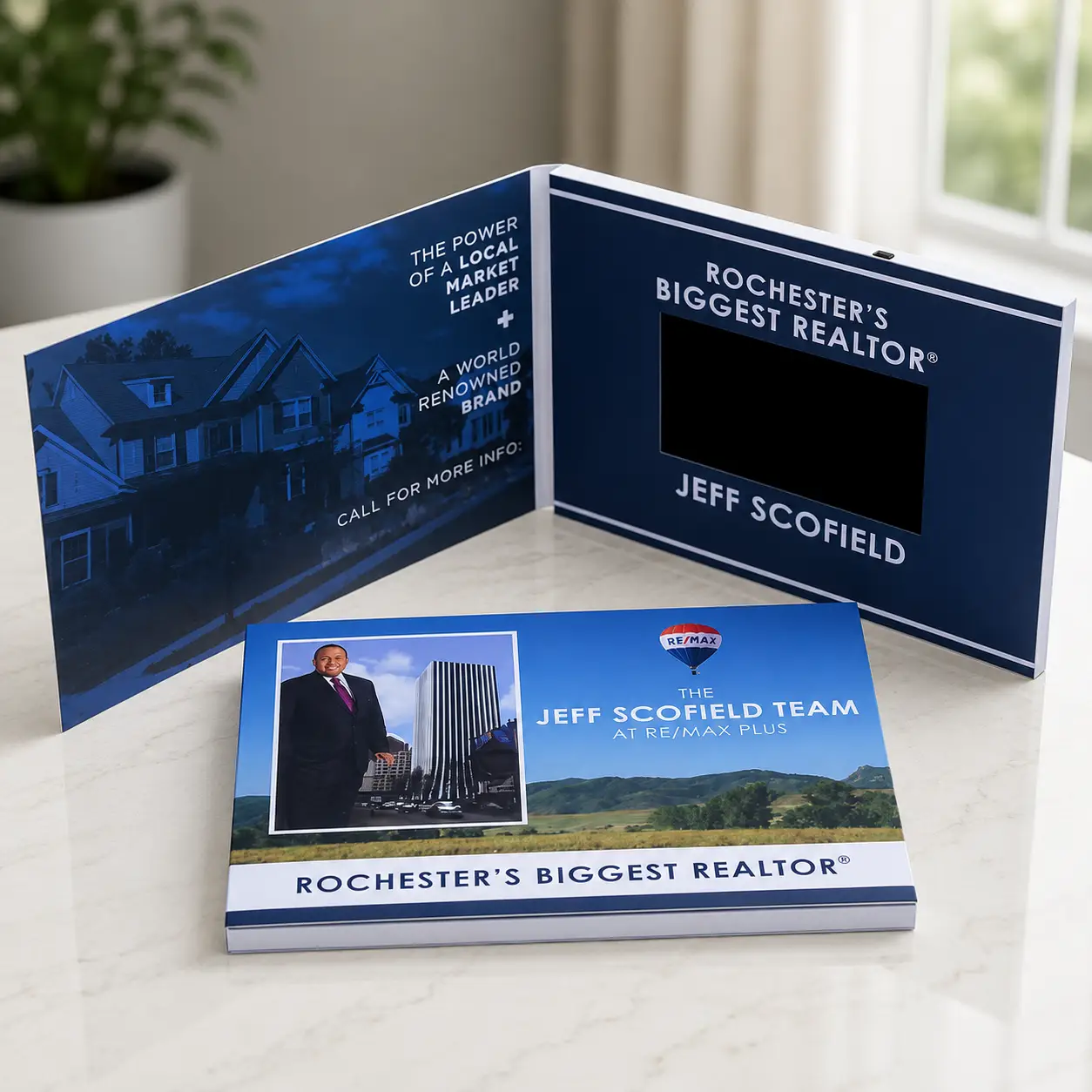
For most standard listing presentation campaigns, soft-touch lamination is the most common upgrade from the base configuration — it creates a noticeably different tactile impression without a large cost increase.4
How Real Estate Clients Manage Cost Over Time
One behaviour that appears consistently across longer-term real estate accounts is cost management through reuse. Agents who have existing video brochure inventory often look for ways to extend it rather than reorder immediately.
One client described their approach directly:
"I think we’re going to find a local printer to print some stickers that we can cover the front and back with so we can reuse the ones we have."
This reflects a practical cost-control mindset even among clients who value the product — and it highlights a key advantage of the video brochure format. Because the electronic components retain their value, the cover can be updated without replacing the entire unit. This is worth factoring into a longer-term campaign budget: the cost of a reorder is lower than the cost of the original batch once the setup and tooling decisions have already been made.
Three Realistic Budget Scenarios
Pilot campaign — agent testing the format
25 units × 5" soft cover = $450 – $550
For agents who want to validate the format in real seller meetings before committing to a larger rollout.
Standard team campaign
100 units × 5" soft cover with soft-touch lamination = $1,600 – $2,000
The most common configuration for agents running consistent listing presentation campaigns across a full quarter. At this stage, the product is typically adopted across an entire brokerage or team.
Premium campaign — luxury listings
50 units × 7" hard cover with foil stamping = $1,600 – $2,000
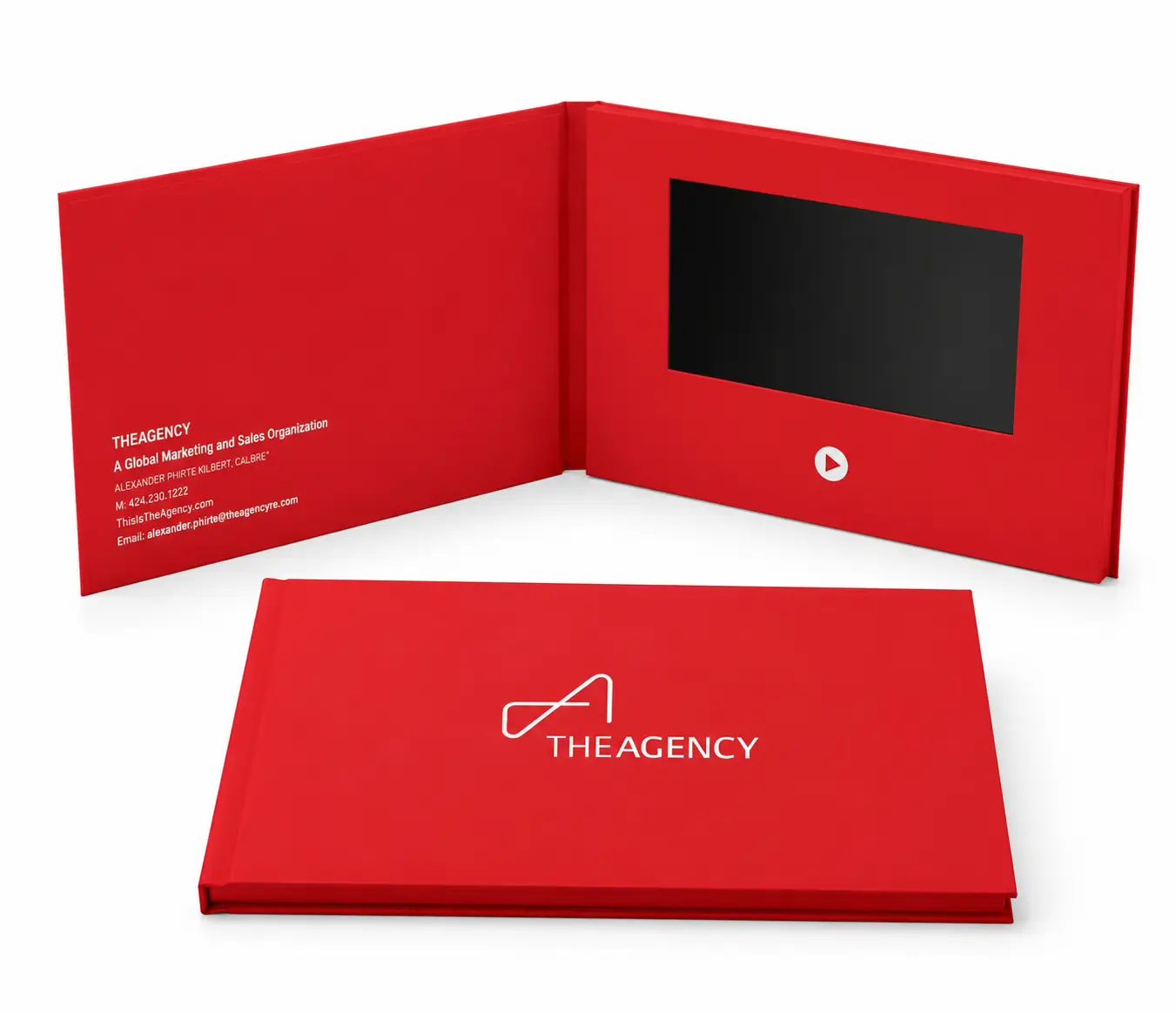
For high-value listings where the brochure itself needs to match the property’s positioning.5
The Transition From Pilot to Rollout
The most important pricing threshold in real estate video brochure campaigns is not the initial unit price — it is the decision to move from a 25–50 piece pilot to a 100+ piece rollout.
That transition only happens once the agent has confirmed that the format is working in actual listing presentations. Once it does, the economics shift significantly: at 100+ pieces, the unit price drops enough that the per-listing cost of the brochure becomes a small fraction of the commission value of the listings it helps win.
For a complete overview of how real estate teams use video brochures across the listing process — from first seller meetings through to ongoing campaign management — see video brochures for real estate listing presentations.
-
Pricing based on factory-direct production for standard campaign quantities as of 2026. Exchange rate and material costs may cause minor fluctuation; final pricing is confirmed at quotation stage based on exact specifications. ↩
-
"Viable at the pilot stage" refers to whether the unit price at the requested quantity fits within the agent’s or brokerage’s initial test budget — typically the deciding factor before moving to design and sample approval. ↩
-
Spine orientation and opening direction affect production complexity slightly more than standard configurations, but typically do not change the quoted price range for a given screen size and cover type. ↩
-
Soft-touch lamination is a velvet-textured coating applied over the printed cover. It is distinct from gloss or matte lamination and is the most frequently requested upgrade among real estate clients moving from a standard to a premium presentation. ↩
-
Luxury campaign pricing assumes a 50-unit order; per-unit cost would decrease at higher volumes, following the same quantity-based pricing pattern shown in the table above. ↩