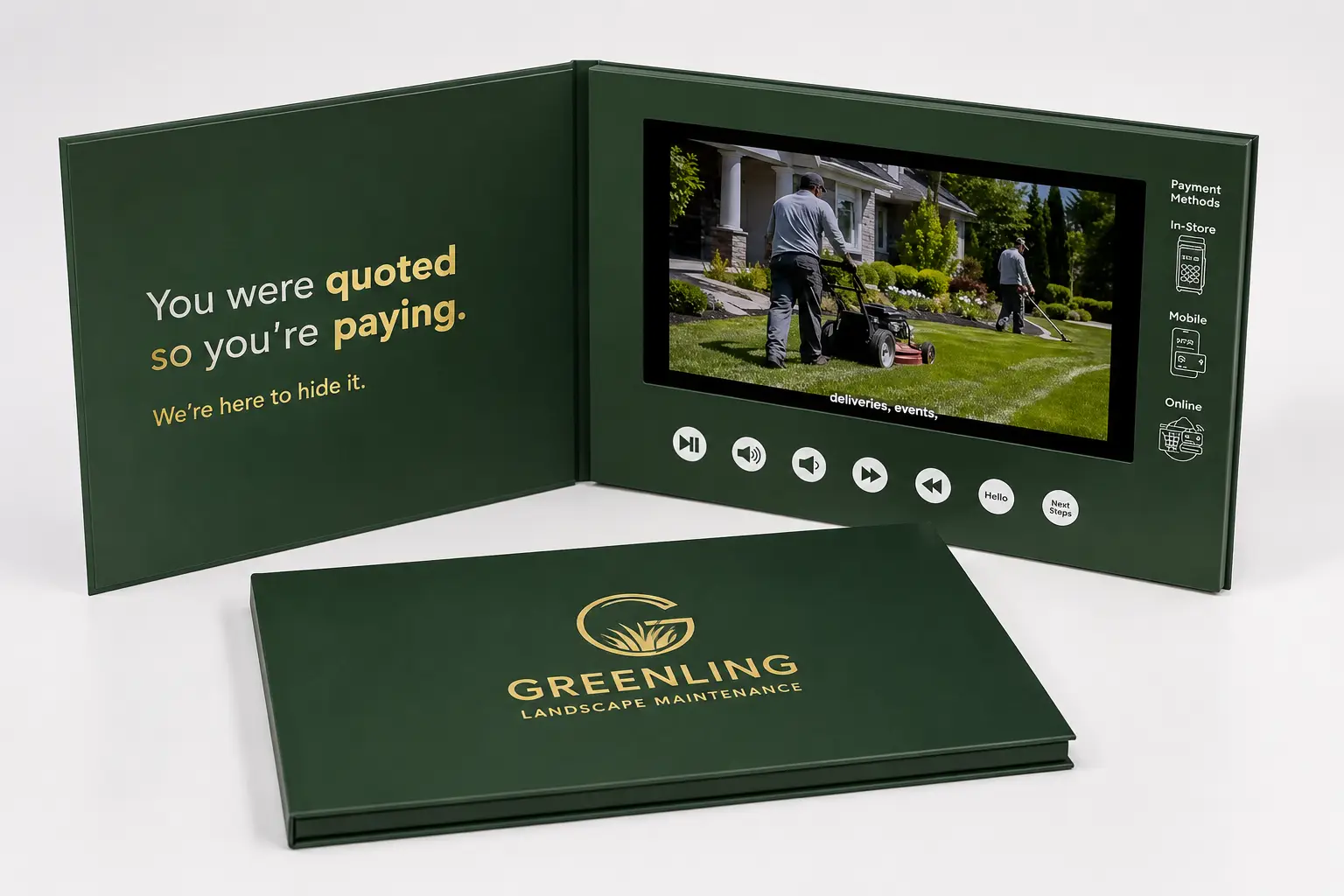
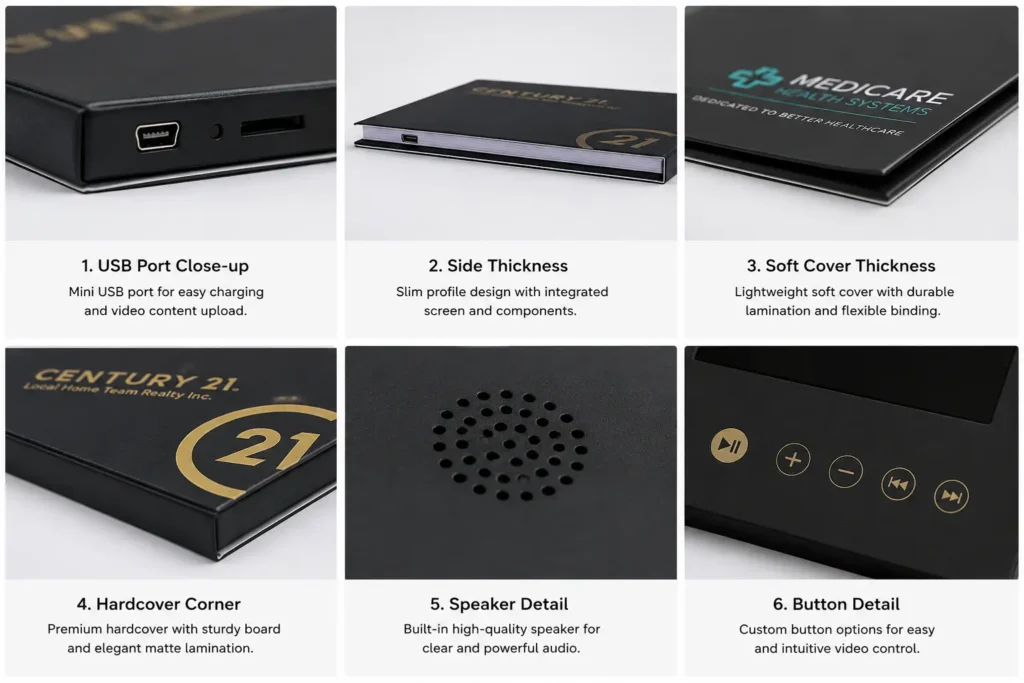
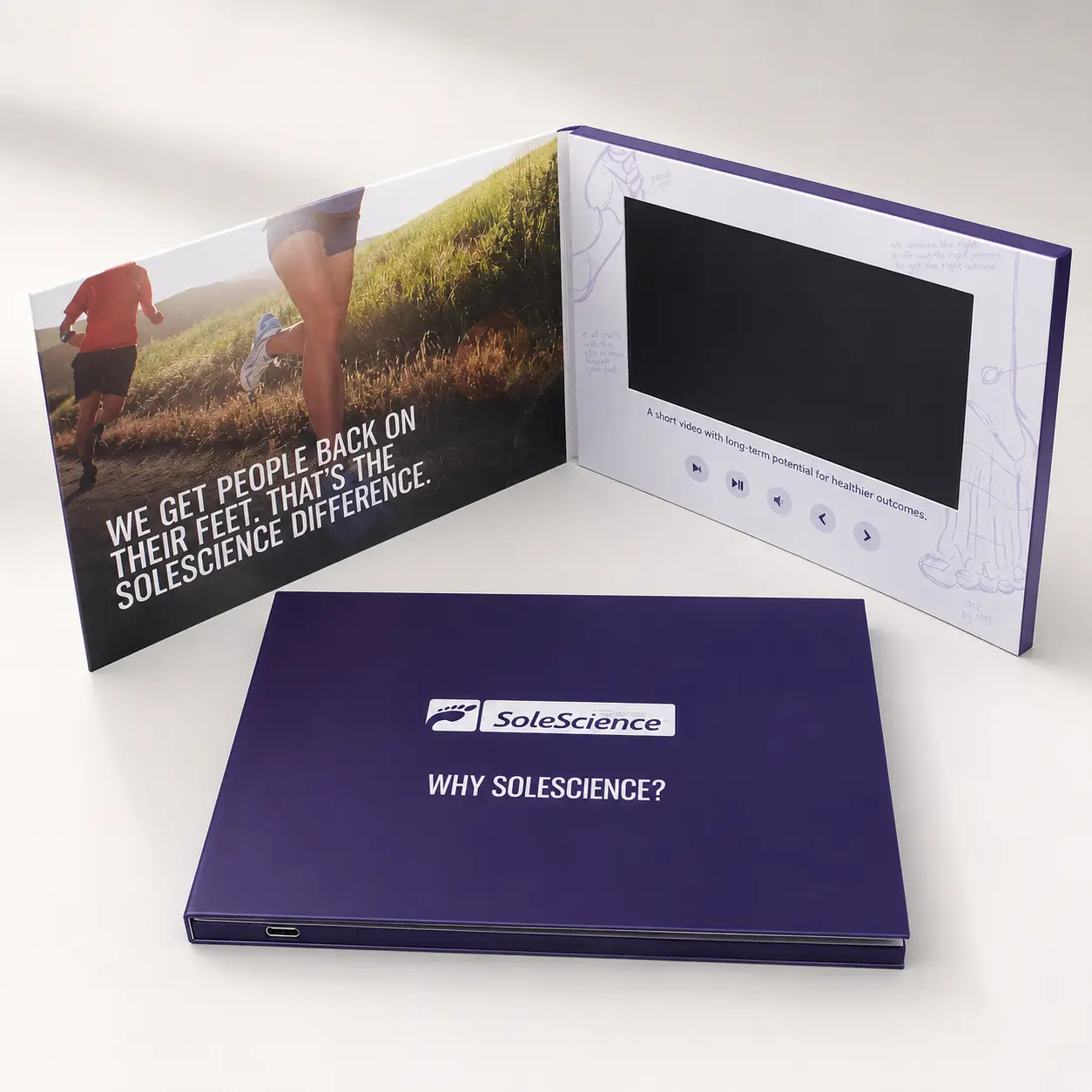
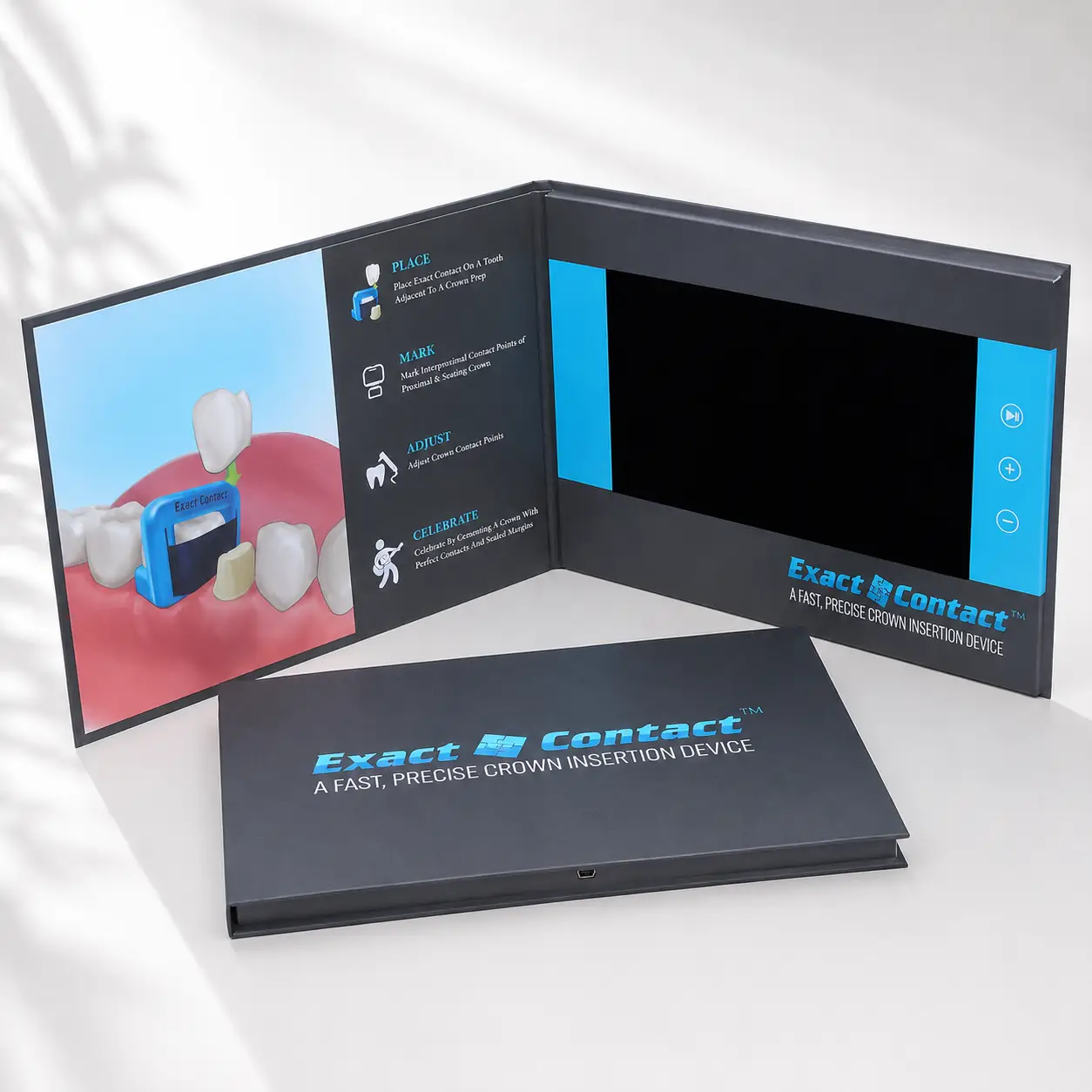
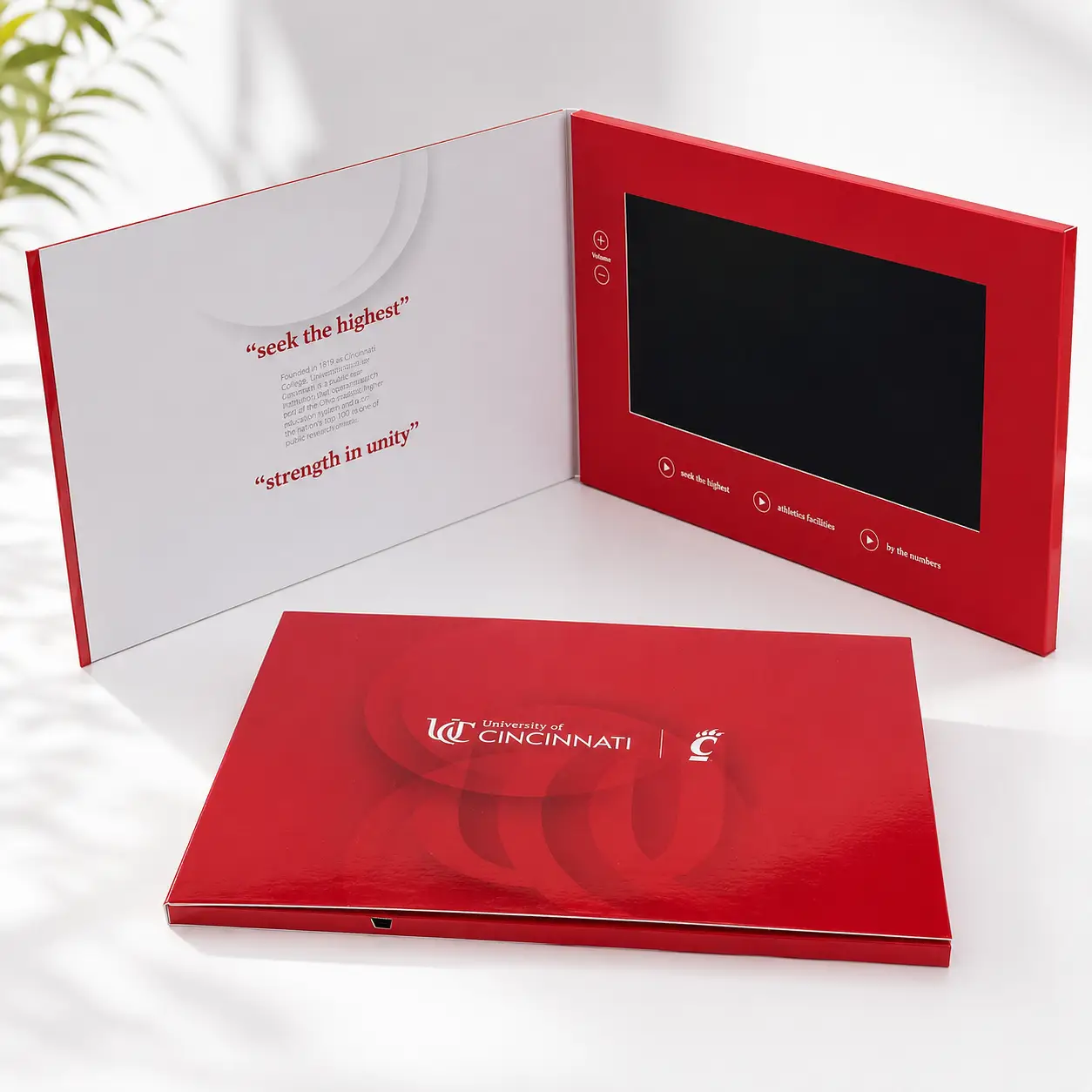
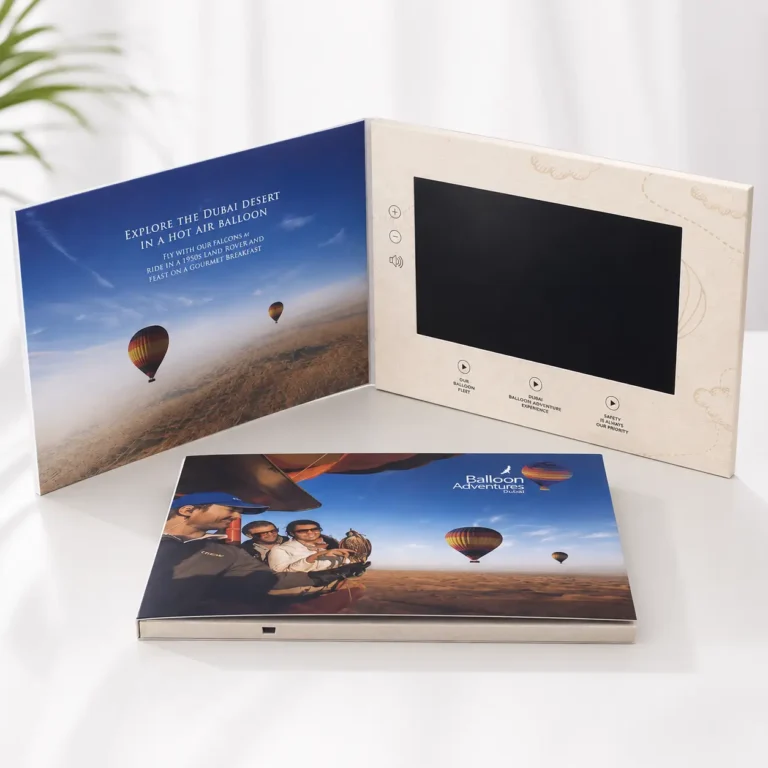
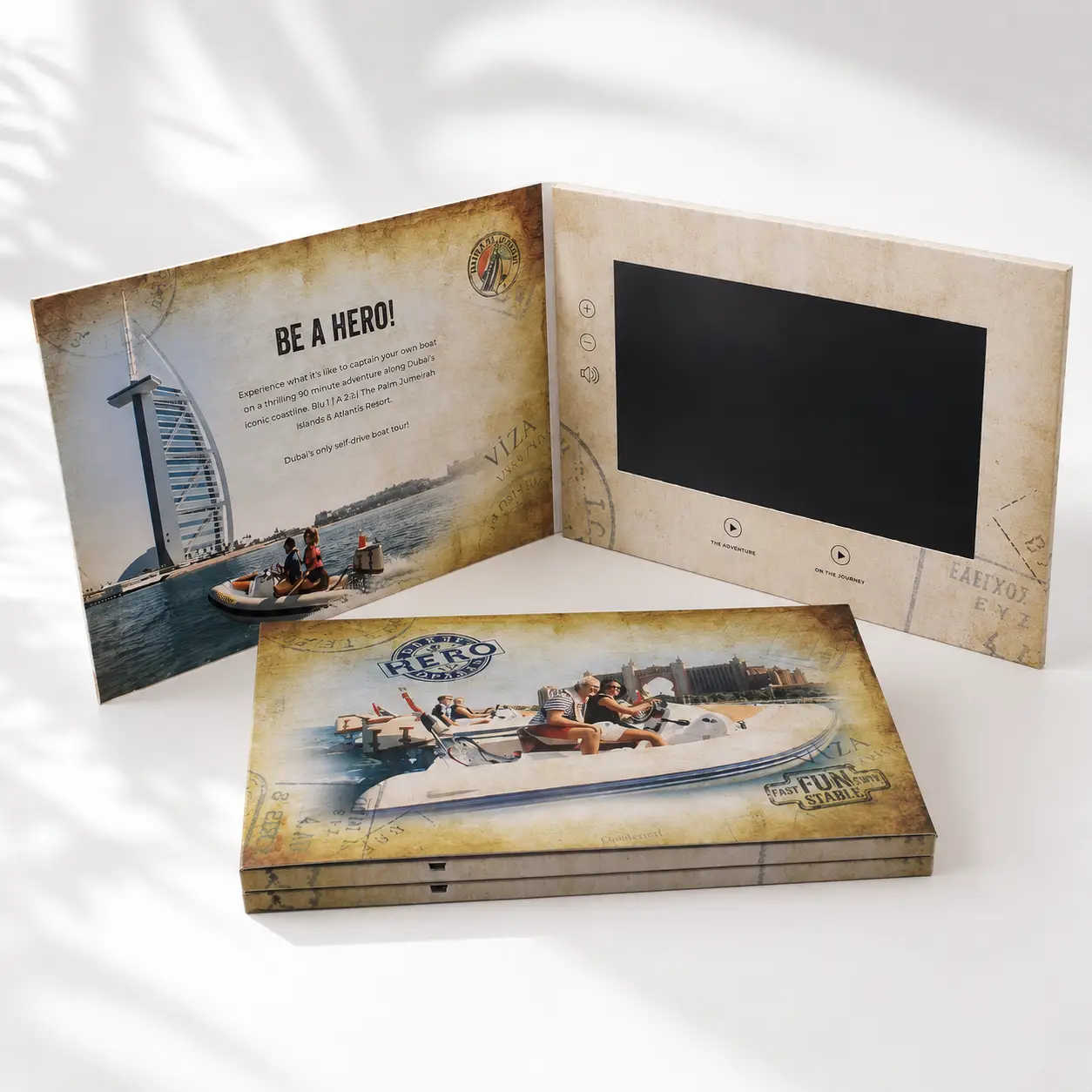
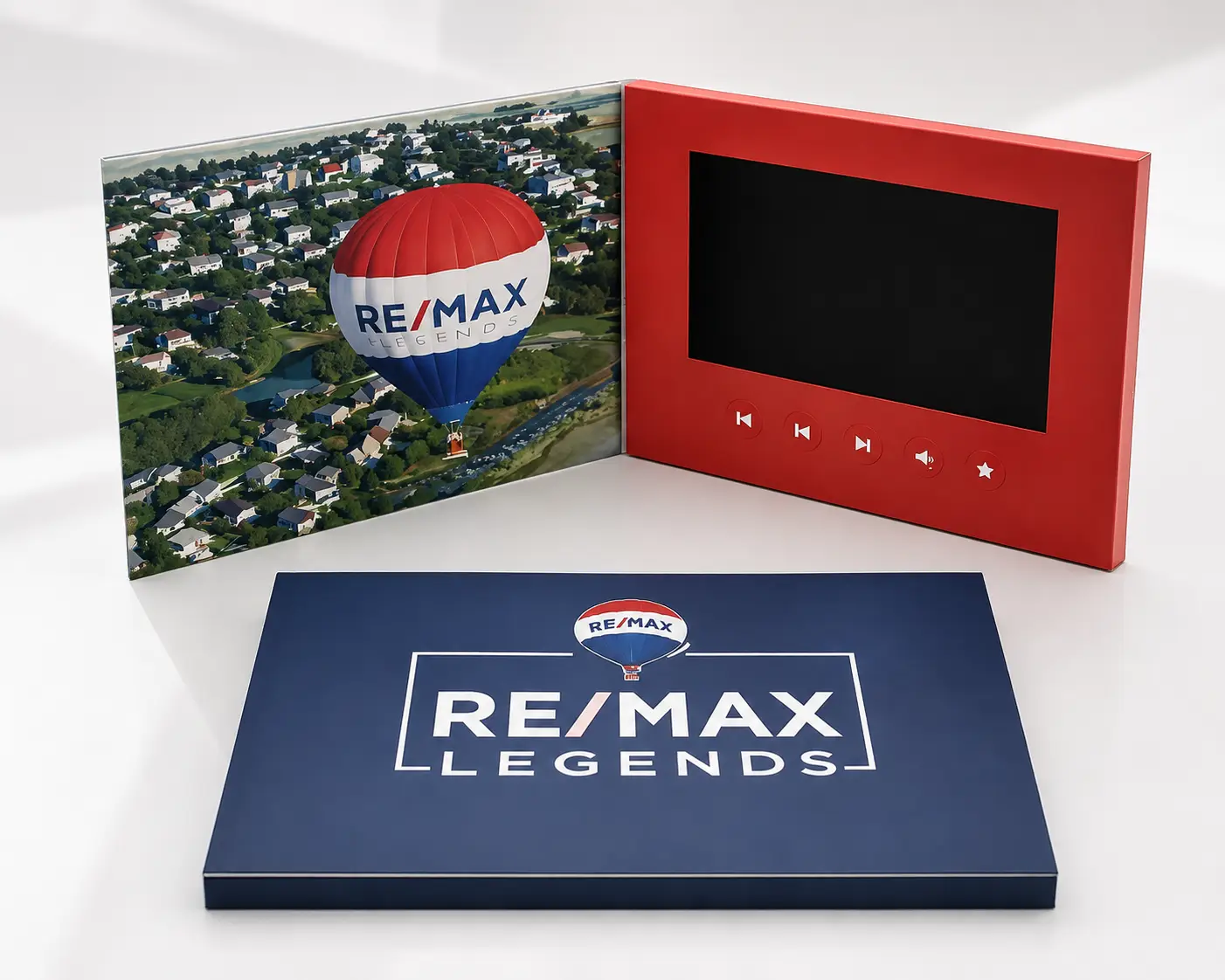
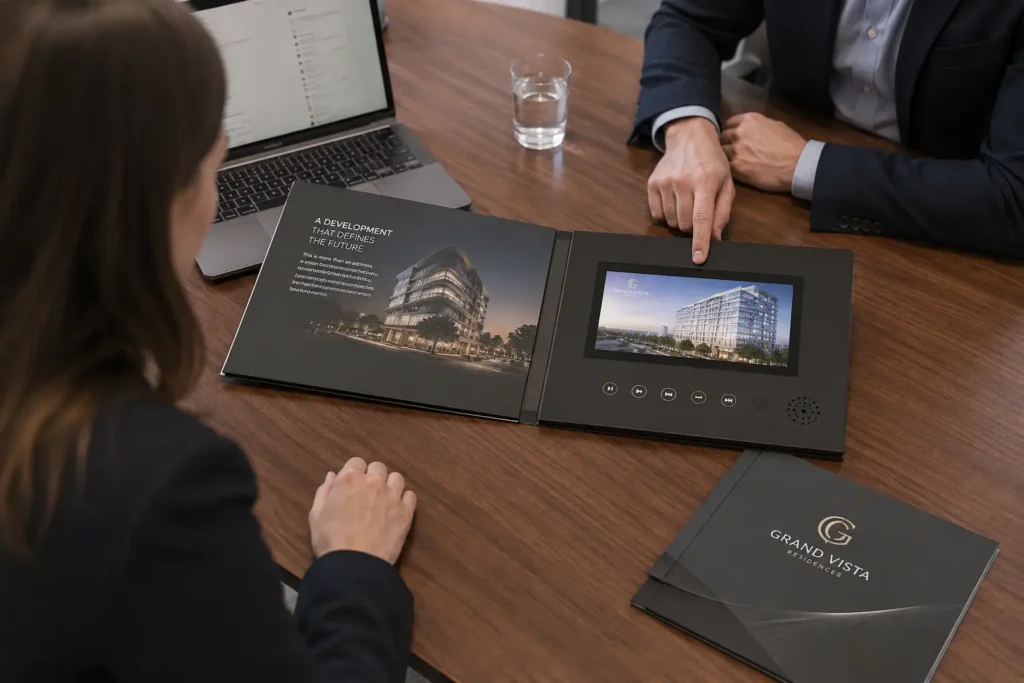
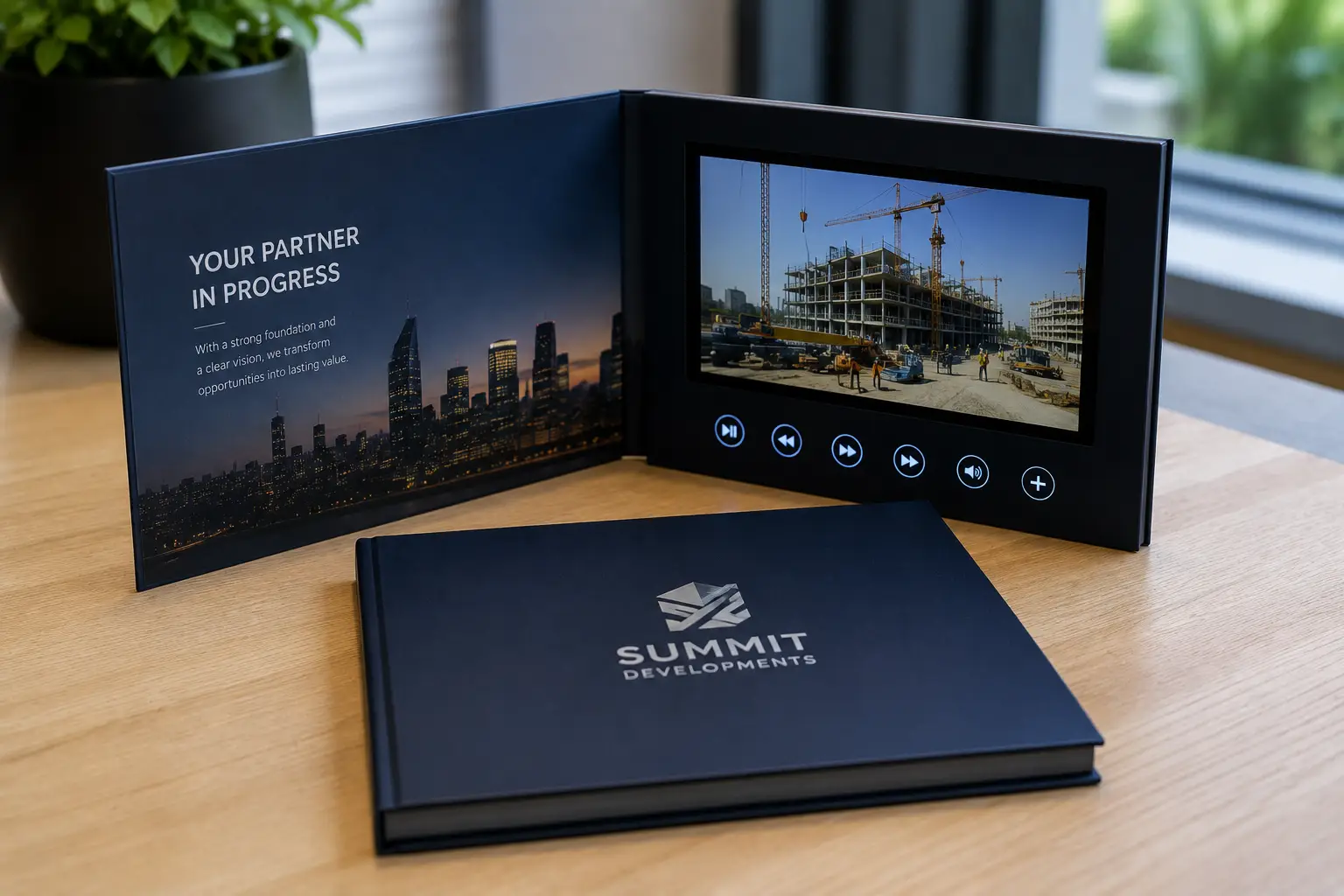
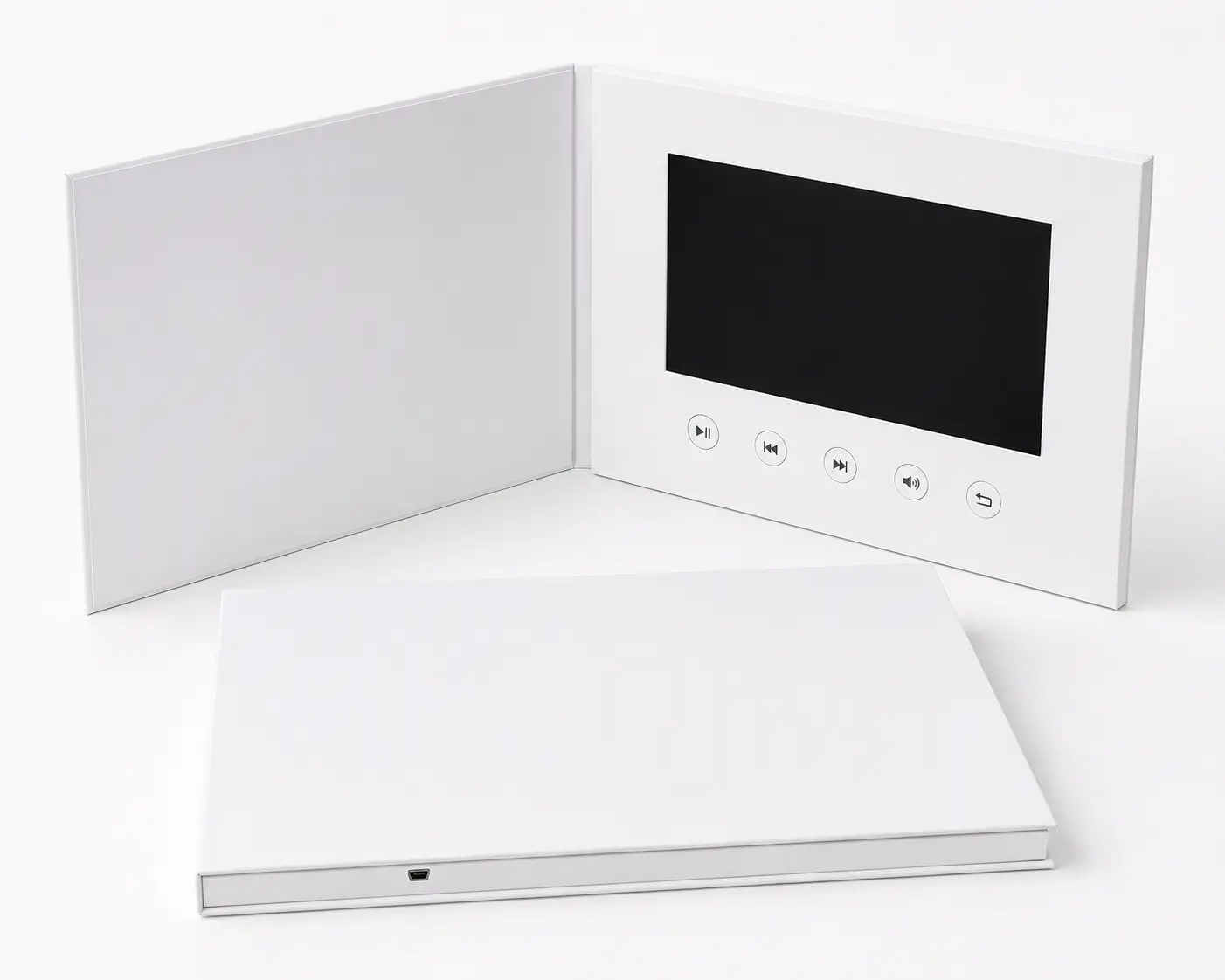
The 10 inch video brochure is the size buyers choose when the piece needs to function as a presentation, not a handout. It’s less common than the 5 or 7 inch — most buyers don’t need this much screen — but for executive presentations, investor decks, luxury brand launches, and multi-product showcases, it’s the format that carries the weight the message needs. If you’re deciding between the 7 inch and the 10 inch, the honest answer is: go 10 inch only if your content genuinely needs the extra real estate — otherwise the 7 inch does the job for less.
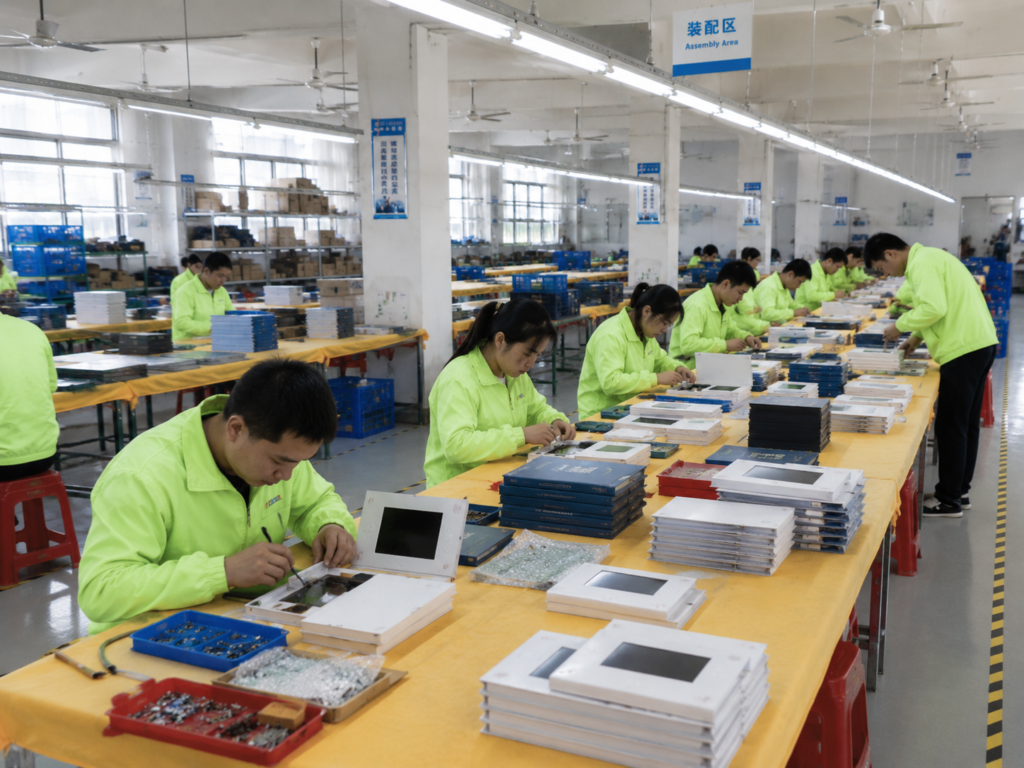
All units are manufactured in-house at our Shenzhen facility. See our factory page.
Get a Free Quote + Artwork Template
| Specification | Detail |
|---|---|
| Screen | 10-inch IPS HD display |
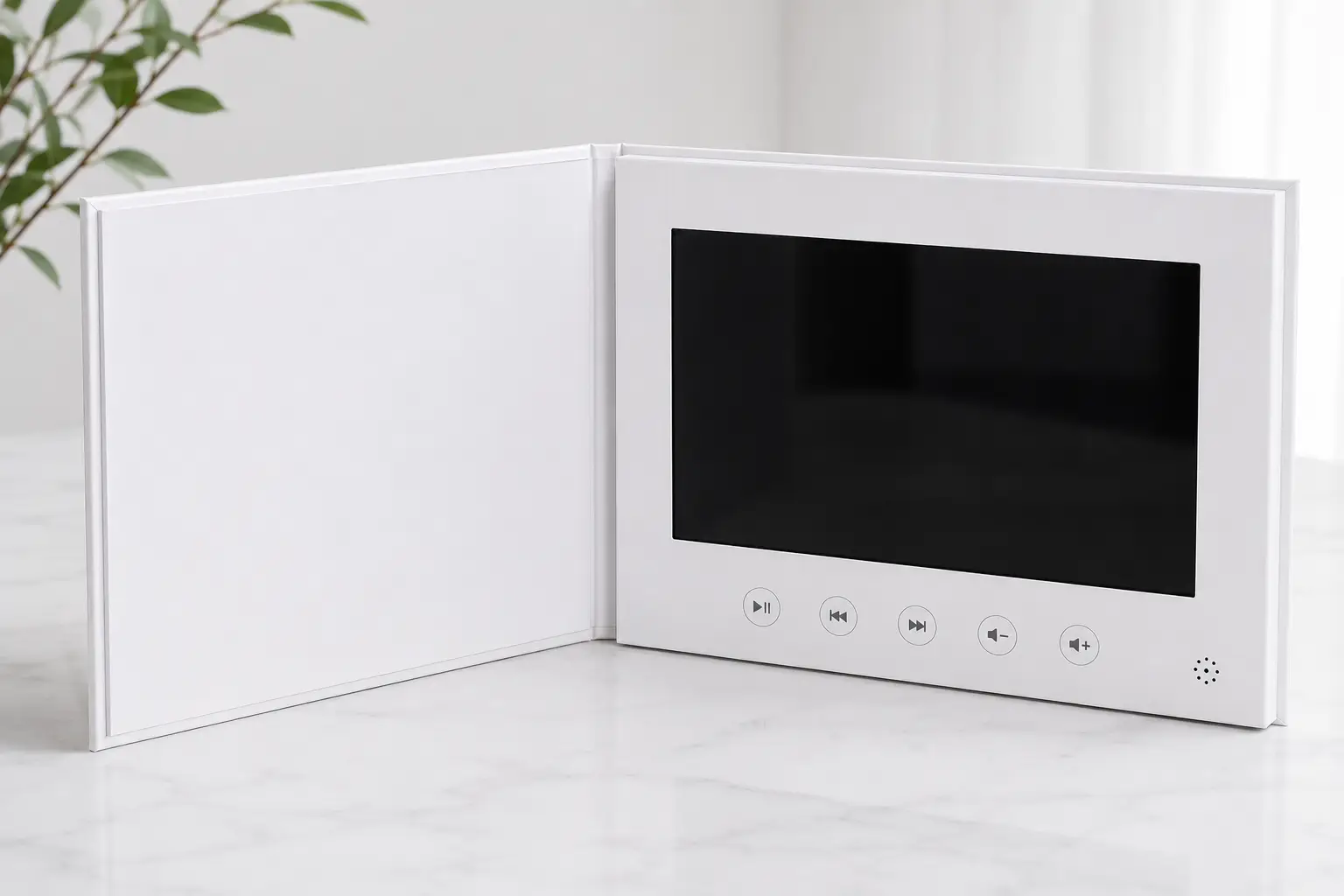
| Navigation | Physical buttons (typically 9–12, depending on video count), touchscreen menu available |
| Cover size | Custom, typically A4 or larger |
| Memory | 512MB – 8GB |
| Battery | 1800mAh rechargeable lithium battery |
| Speaker | Built-in, dual speakers available |
| Cover options | Hardcover (standard for this size) |
| Typical order size | 50–150 pcs, depending on use case |
| MOQ | 1 piece |
| Production time | 10–15 days |
Most corporate and hospitality buyers land on: hardcover + 4GB + 10–12 buttons. Common uses: executive and investor presentations, luxury brand and product launches, multi-product sales tools, architecture and design proposals, trade show centerpieces, keepsake and client-relationship pieces, hotel and hospitality partner distribution.
Sample orders typically ship within 2 business days.
Most buyers choosing the 10 inch are past the basic size decision — they already know a smaller format won’t carry their content. The remaining decisions are:
1. How many buttons, and mapped to what? This scales with how many distinct videos or products you need to reach directly. One button per video is the standard rule — a buyer running 10 different product lines typically uses 10 play buttons plus volume up/down, landing around 12 total. We confirm the button-to-video mapping against your file list before production, since it’s the most common spec detail to get wrong at this complexity.
2. How much memory? 512MB covers a single strong presentation video. Once you’re navigating between several videos, plan for 4GB–8GB so quality isn’t compressed to fit. Buyers combining multiple photos with multiple videos — a common request at this size — should size memory to the combined file total, not just the video length.
3. Touchscreen menu, or physical buttons? Touchscreen looks more premium and suits a single polished presentation with an on-screen menu. Physical buttons are more durable in the field and easier for a non-technical viewer to operate correctly on the first try — the more common choice for pieces that will pass through many hands, whether that’s hotel concierge desks or a string of client meetings.
For a closer look at memory sizing across all our formats, see our 5-inch and 7-inch configuration guides — the underlying logic is the same, just scaled to more content.
Buttons & navigation. Standard builds use physical buttons, one per video, plus volume controls — 9 to 12 buttons is typical for a multi-product line. Touchscreen menu navigation is also available for buyers who prioritize a premium on-screen experience over button durability. Whichever you choose, the button (or menu item) count should match your video count one-to-one; we verify this before production starts.
Memory. 512MB, 1GB, 4GB, or 8GB. At this screen size, buyers are usually running longer or multi-video content — sometimes combined with a large photo library — so 4GB and 8GB are common choices for anyone with more than one or two videos loaded.
Cover & finish. Hardcover is standard at 10 inch — the format is rarely used as a low-cost giveaway. Finishing options include debossed leather texture, foil stamping, spot UV, and embossing. We confirm every finishing detail in writing before production, since these are the specs most likely to shift during design review.
Extras. USB-C charging is available on request in place of the standard connector. Internal pockets can be added for buyers who want to include printed materials alongside the screen. Dual speakers are available for stronger audio presence in presentation or trade show settings.
A 10 inch unit typically runs noticeably higher per piece than a 7 inch at the same memory tier. That difference isn’t markup — it’s the larger LCD panel itself, a bigger battery to drive it, a larger printed hardcover, and more packing weight per unit, which raises shipping cost proportionally too. None of that is a reason to avoid the 10 inch when your content needs it — it’s just useful to understand before comparing a quote against a smaller format.
Covers are printed full-color (CMYK), and we accept artwork in AI, PDF, or CDR format. Free templates are available, and our team can handle simple layout work at no charge.
For premium finishing — foil stamping, spot UV, embossing, USB-C, dual speakers — get a quote with your spec. Costs depend on finish type, cover material, and quantity.
A Canadian real estate team first tested the video brochure at 7 inch — a welcome video and photos for new clients, designed so the book could be reused: after a listing sold, the team would collect the book back, swap the welcome video for the client’s own home footage and photos, and return it as a personal keepsake. The sample shipped, the team liked it, and came back months later ready to scale up — now running two videos and 100 photos per book, plus a request for volume controls the original sample didn’t have. After comparing 7 inch pricing at two memory tiers, they asked what the next size up would cost, and once they saw the 10 inch option, skipped the sample stage entirely and ordered 50 units directly at 4GB, with a 9-button layout built to their own reference image. Payment was confirmed and production started the same day.
A Dubai-based tourism operator has reordered the 10 inch as a multi-product sales tool for several years running, using it to showcase ten separate tour and experience offerings — desert safaris, balloon flights, adventure packages — through one button per product plus volume controls, distributed through hotel and concierge partners. On the most recent reorder, the order quantity changed mid-negotiation — from 150 units down to 100 — after an internal budget meeting on the client’s side, with pricing adjusted accordingly and a revised invoice issued the same day. Because this is a corporate account, payment moved through a formal approval chain — CEO sign-off, then a wire transfer via the company’s accounts team — rather than a quick card payment. On an earlier order, when one unit arrived with a damaged screen, the fix was handled directly and without friction.
Both point to the same pattern: the 10 inch is rarely a first order. It’s what buyers move up to once a smaller build has proven the concept, or once the sheer number of things they need to show has outgrown a simpler layout.
The examples above are based on real customer orders. Company names and certain identifying details have been anonymized to protect client confidentiality.
Buyers scaling up from a proven smaller format. The move to 10 inch is usually triggered by a specific content problem — more photos, longer video, a second video track needing its own button — not by ordering size for its own sake.
Multi-product sales and distribution partners. Tour operators, product lines, and dealer networks that need to showcase several distinct offerings in one piece, one button per item, distributed through partner channels rather than sold direct.
Corporate accounts with a formal purchasing process. Buyers whose orders move through internal approval and finance teams before payment — quantities and specs sometimes shift mid-process, and the supplier relationship needs to hold up across a wire transfer and an invoice revision, not just a quick checkout.
Executive, investor, and luxury launch teams. Board presentations, luxury brand and product launches, architecture and design proposals — anywhere the object itself needs to signal the same caliber as the message inside it.
Real estate and client-relationship teams building a keepsake product. A book that starts as a welcome gift with a team introduction video and gets reissued later with a client’s own footage — a use case that specifically outgrows a 5 or 7 inch build once photo count and video length increase.
Cover files should be supplied in AI, PDF, or CDR format, with a 3mm bleed and 300 DPI minimum resolution. Video files should be MP4 (H.264, 1024×600 resolution recommended), sized to your selected memory tier. For multi-button builds, provide a clear list mapping each video file to its intended button — this is the single fastest way to avoid a production delay.
Most video brochure orders pass through four separate hands before they reach the customer: a printer for the cover, a trading company that sources the electronics, an assembler that puts the two together, and a freight forwarder for shipping. At the 10 inch level — where button-to-video mapping, finishing specs, and sometimes formal purchasing processes are all in play — every one of those handoffs is a place a detail gets lost or a timeline slips.
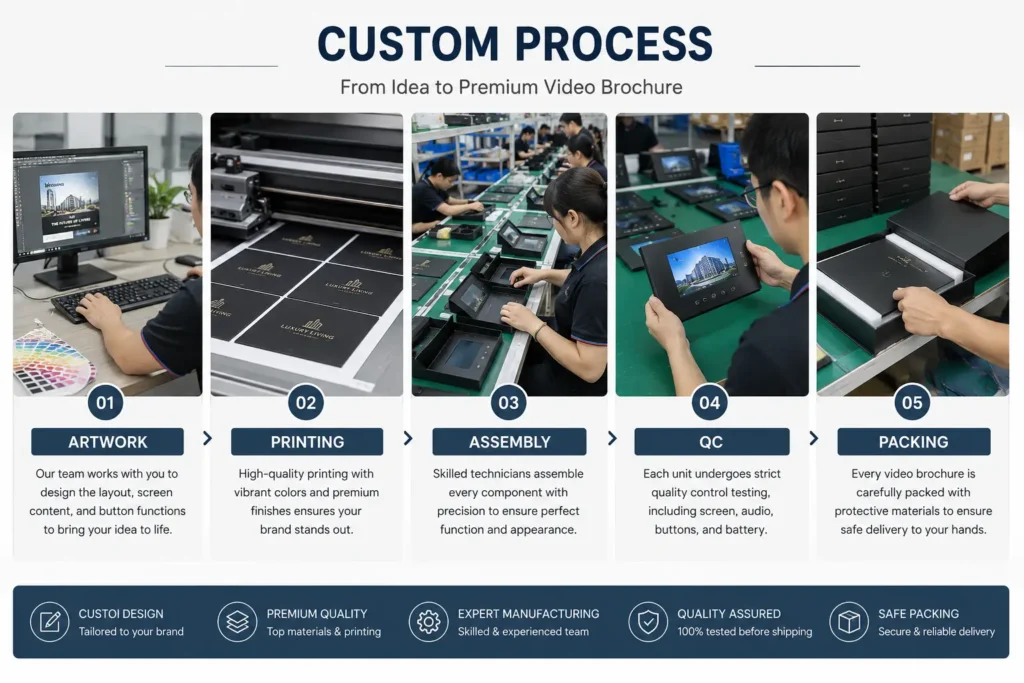
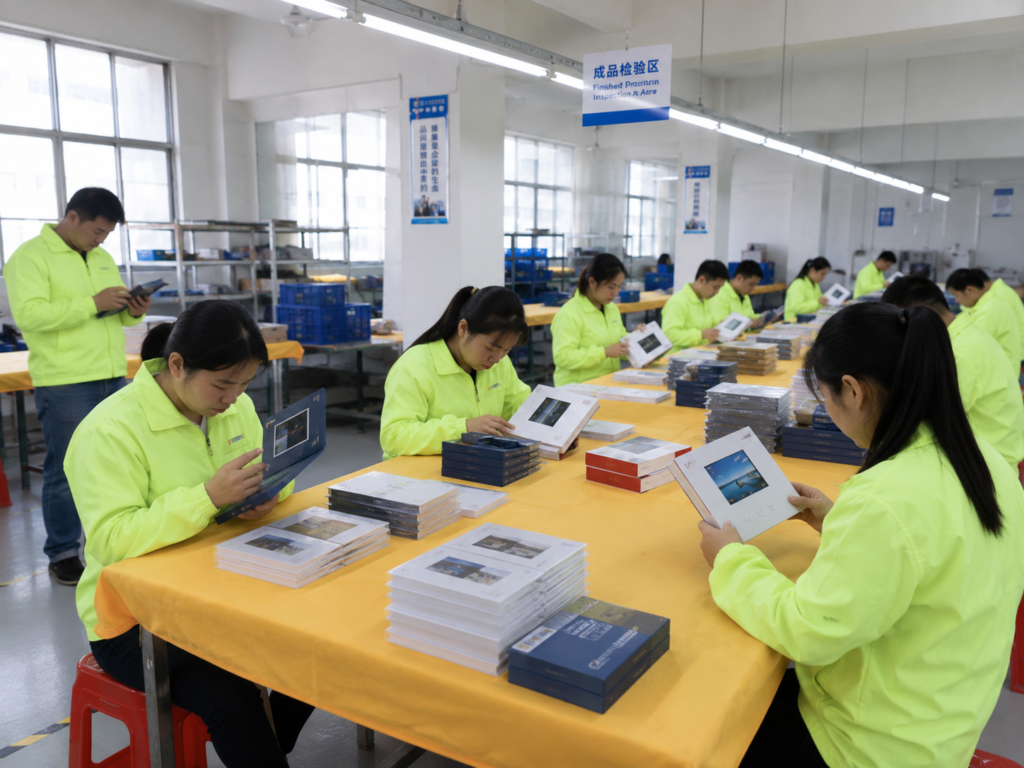
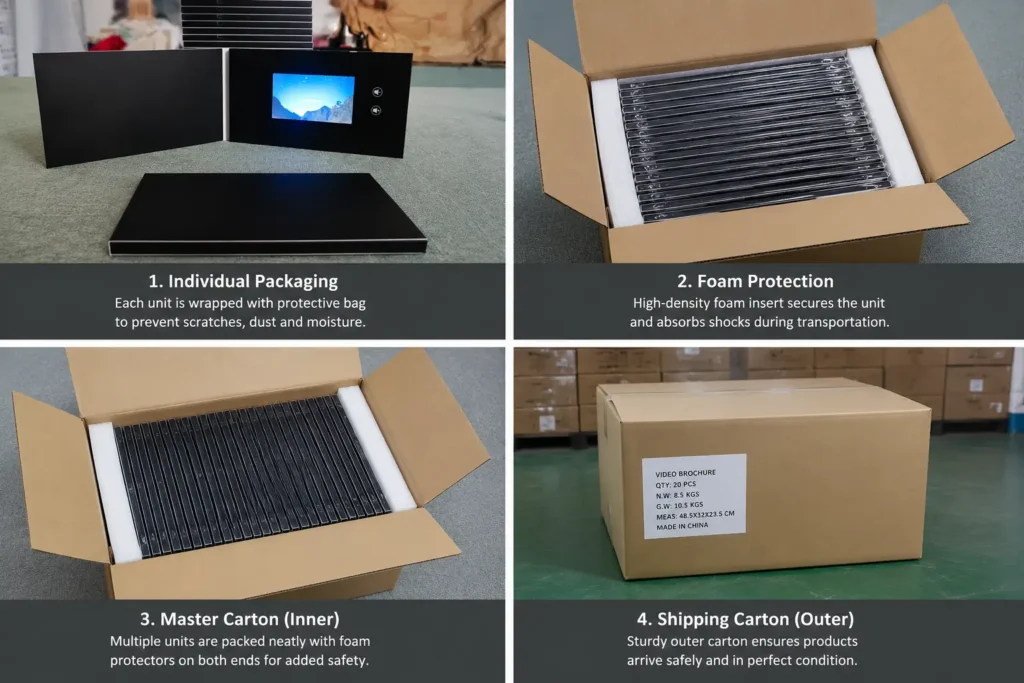
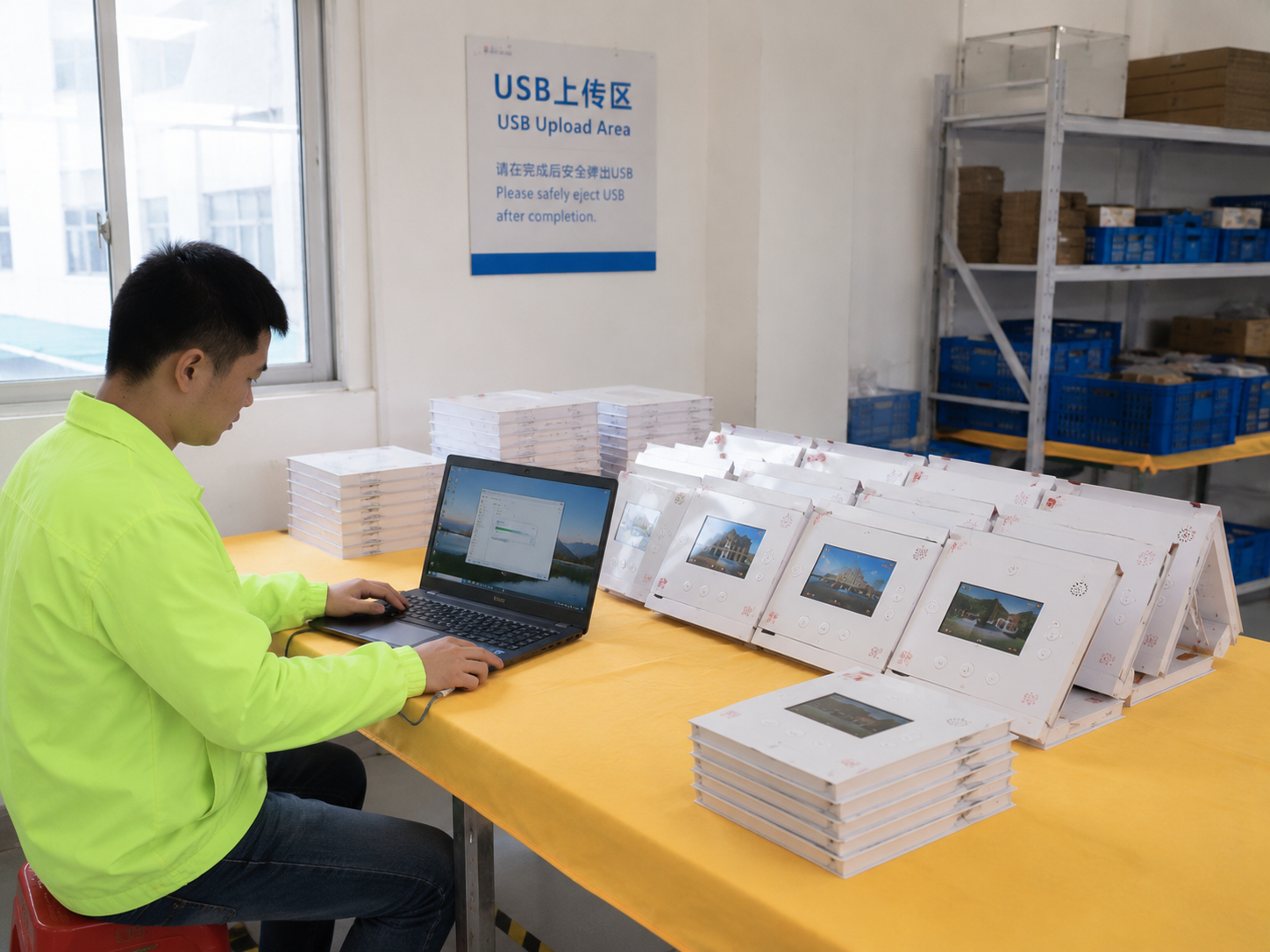
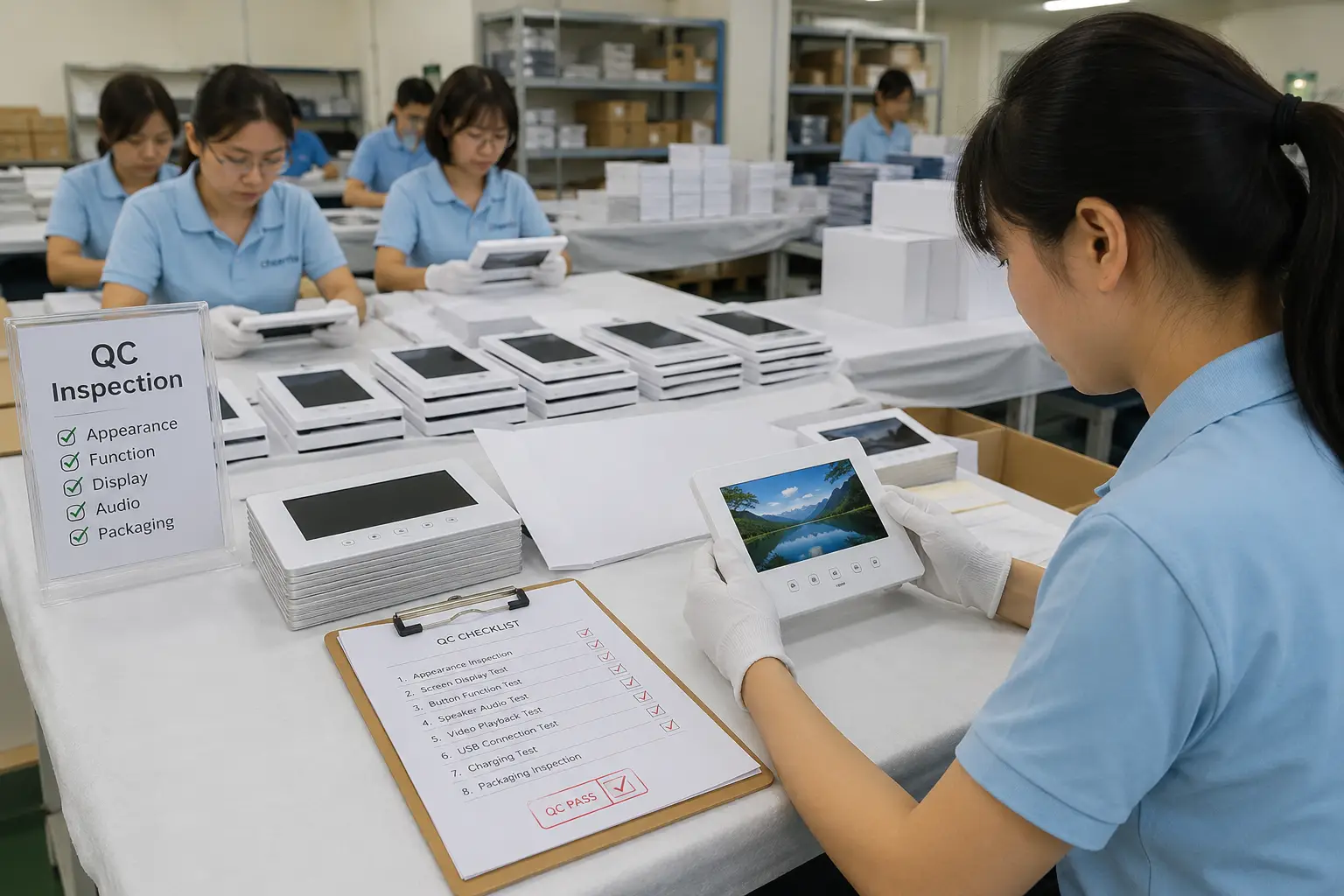
We run artwork, electronics assembly, quality testing, packing, and shipping under one roof and one team. When an order quantity changes mid-negotiation, the same person who quoted the original price can revise it and reissue an invoice the same day — not relay the change through two other companies first. When a corporate buyer needs a formal invoice for their accounts team, or a wire transfer instead of a card payment, we handle that directly. And when something does go wrong — in one case, a single unit arrived with a damaged screen — we resolve it directly with the buyer, not through a reseller layer that adds another round of delay.
We’ve supplied 10 inch units to real estate teams, tourism and hospitality operators, and corporate buyers across North America and the Middle East. Given the complexity and cost at this size, we’d rather spend an extra round of emails getting the spec exactly right than rush a large order into production.
Choose the 10 inch only if your content genuinely needs the extra screen — multiple products, a growing photo and video library, or a presentation that’s outgrown a smaller build. For most single-message use cases, the 7 inch delivers the same impact for less cost and less shipping weight.
The larger LCD panel, bigger battery, larger printed hardcover, and heavier shipping weight all scale up together — it’s a function of the physical build, not a pricing markup.
One per video is the standard rule. A buyer showcasing 10 products typically uses 10 play buttons plus volume up/down, for around 12 total. We confirm your file-to-button mapping before production starts.
Touchscreen suits a polished, single-operator presentation. Physical buttons are more durable when the piece passes through many hands — trade show visitors, hotel concierge desks, or a string of client meetings — and easier for a non-technical viewer to use correctly on the first try.
512MB covers a single strong presentation video. If you’re combining multiple videos with a photo library, plan for 4GB–8GB so nothing needs to be compressed to fit.
Yes. We regularly work with corporate accounts that require a formal invoice, and can accommodate wire transfer payment in addition to card and digital payment links.
Let us know as soon as possible — we can revise pricing and reissue an invoice the same day in most cases.
No, soft cover is popular too, especially if you’re ordering in higher volume or keeping cost down. Hardcover is usually the pick when the piece needs to feel premium, think investor decks or luxury launches. Foil stamping and spot UV work best on hardcover, but you can go either way on the cover itself.
Yes. We offer DDP shipping to the US, UK, Europe, and most other markets — duties and customs cleared on our end.
Yes. Connect via USB, delete the old file, copy the new one — about 2 minutes per unit.
Yes. MOQ is 1 piece, though most 10 inch buyers order a sample first given the higher unit cost.
Tell us about your presentation, estimated quantity, and destination. We’ll recommend the right configuration, prepare a factory-direct quotation, and provide the artwork template you need to get started.
You’ll receive:
✓ Configuration recommendations
✓ Factory-direct quotation
✓ Free artwork template
✓ File compatibility check
✓ Shipping options
We will contact you within 1 working day, please pay attention to the email with the suffix “@cheertrend.com” or “cheertrend@gmail.com”.