


I often hear the same question from buyers before they place an order. They are not worried about watching a video once. They are worried about reliability. They want to know whether the brochure will still work when it reaches a VIP prospect, an investor, or a trade show visitor. Nobody wants a presentation to stop halfway because the battery runs out.
Most video brochures provide between 1.5 and 2 hours of continuous playback on a full charge. Larger batteries can extend playback time to 4–6 hours or more. Actual battery life depends on battery capacity, screen size, screen brightness, speaker volume, video settings, and usage frequency.
Many buyers focus only on battery capacity, but that number tells only part of the story. A 1500mAh battery may be more than enough for one project and completely unsuitable for another. Understanding how battery life is measured can help you choose the right configuration while avoiding unnecessary cost.
How do I calculate the battery life I actually need for my project?
I have seen many buyers request the largest battery available because they assume bigger is always better. In reality, battery selection should be based on how the brochure will actually be used.
The right battery capacity depends on the number of presentations, video length, screen size, and how often the brochure will be opened. Most direct mail campaigns require less battery capacity than trade show or touchscreen applications.

The first thing I recommend is estimating total daily playback time.
A luxury real estate brochure may only play a three-minute property video once or twice. A medical device company may use the same brochure repeatedly during sales meetings. A trade show display may be opened dozens of times throughout the day.
These projects have completely different power requirements.
| Usage Scenario | Recommended Battery Capacity |
|---|---|
| Direct Mail Campaigns | 1200–1500mAh |
| Sales Presentations | 1500–2500mAh |
| Product Launch Kits | 2000–3000mAh |
| Trade Shows | 2500–5000mAh |
| Touchscreen Projects | 4000–5000mAh |
To put this in perspective: a standard 1500mAh battery can easily play a three-minute property video more than 30 times before needing a recharge. For most direct mail campaigns, that is far more capacity than the project will ever require.
Many people mistakenly calculate battery needs based on event duration instead of actual playback time. A two-day trade show does not necessarily require sixteen hours of battery life. Most visitors only watch a short portion of the content, and brochures are often recharged overnight.
Battery capacity should therefore match realistic usage rather than worst-case assumptions.
Another important distinction is the difference between playback time and standby time. Most video brochures can hold a charge for several months when stored properly.1 The main limitation is active video playback, not shelf life.
For most marketing campaigns, a standard battery is sufficient. Larger batteries become valuable when brochures are expected to handle repeated demonstrations, touchscreen interaction, or long product presentations.
Why can two video brochures with the same battery capacity perform differently?
Many buyers assume that two video brochures with the same battery rating should provide exactly the same runtime. That rarely happens in practice.
Two video brochures with identical battery capacities can deliver different playback times because screen size, brightness, speaker volume, touchscreen functions, and video optimization all affect power consumption.
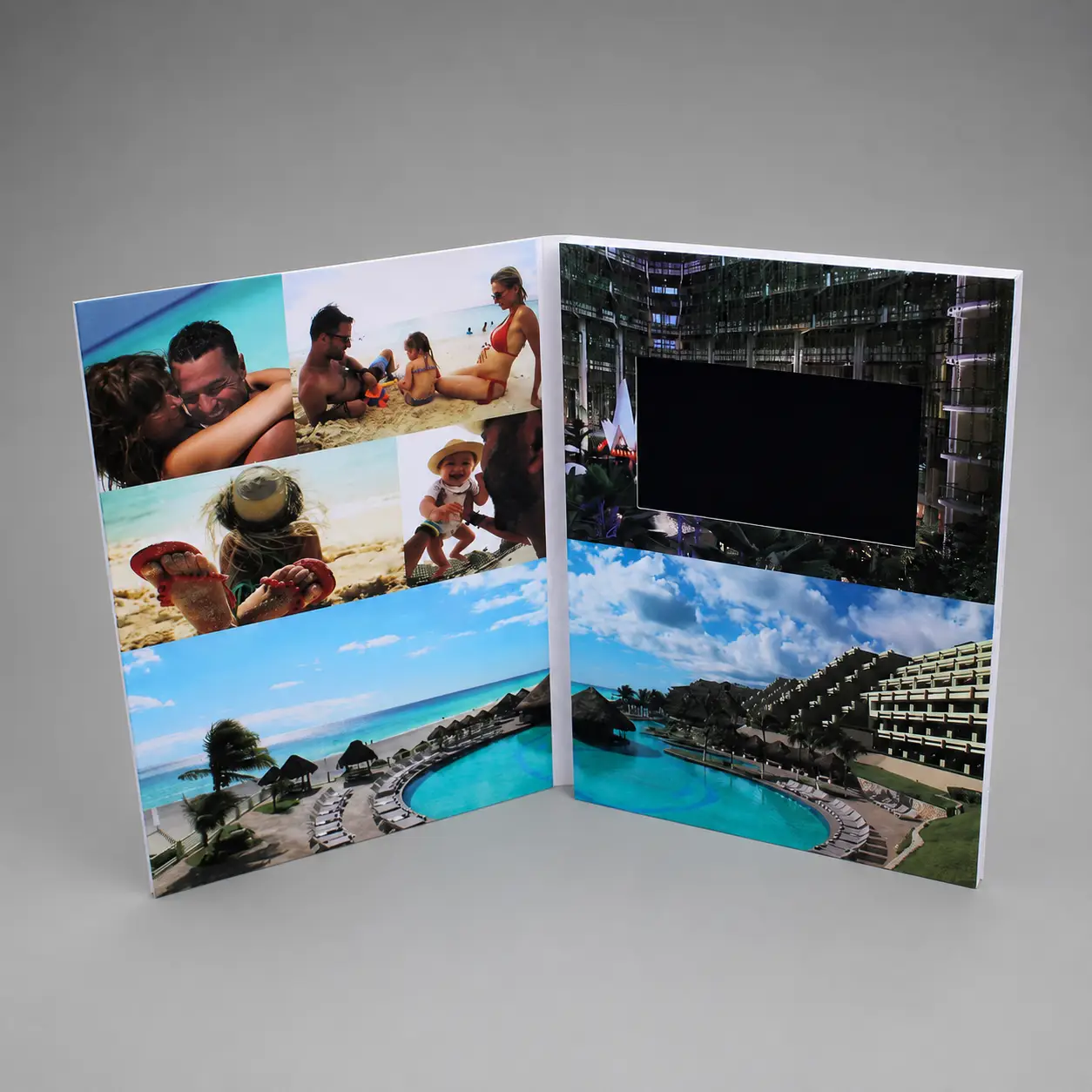
Battery life is influenced by how efficiently the system uses energy. The battery acts as the fuel source, but the hardware determines how quickly that fuel is consumed.
A larger screen naturally requires more power than a smaller one. A touchscreen consumes more power than a standard screen. Higher brightness settings increase power draw. Higher speaker volume also reduces runtime.
The video itself can have a surprisingly large impact.
| Factor | Impact on Battery Life |
|---|---|
| Screen Size | High |
| Screen Brightness | High |
| Touchscreen Function | High |
| Speaker Volume | Medium |
| Video Bitrate | Medium |
| Playback Frequency | Medium |
One issue I frequently encounter is poorly optimized video files. Some customers export videos using extremely high bitrates because they believe bigger files automatically produce better quality.
That assumption is often wrong.
In one case, a customer supplied a 60-second video that occupied 385MB of storage. Another project included a seven-minute video that used only 400MB. Both videos looked excellent on the screen, but the second file was far more efficient.
A properly optimized H.264 MP4 file typically delivers excellent image quality while reducing unnecessary processor workload.2 When the processor works less aggressively, overall power consumption decreases. This can improve both battery performance and playback stability.
Battery life is therefore influenced not only by hardware but also by content preparation. The same battery can perform very differently depending on how the video files are created.
How much battery capacity do I need for trade shows, direct mail, or sales presentations?
Battery requirements vary significantly depending on the project type. The best battery for a direct mail campaign is often very different from the best battery for a trade show display.
Most direct mail campaigns work well with standard battery capacities, while trade shows, touchscreen projects, and continuous demonstrations often benefit from larger batteries that provide additional runtime and reliability.

For direct mail campaigns, the recipient usually opens the brochure once, watches the presentation, and then stores the item. In these situations, standard battery configurations are normally more than sufficient.
Sales presentations involve more frequent use. A sales representative may show the brochure to multiple prospects throughout the week. While a standard battery often works well, many companies prefer additional capacity to reduce charging frequency.
Trade show applications create the highest demand. The brochure may be opened repeatedly throughout the day, often by dozens of visitors. This repeated usage increases cumulative power consumption and creates a greater need for battery reserve.
Touchscreen projects introduce another variable. Interactive menus, touch controls, image galleries, and multiple video selections require additional processing power. These systems generally benefit from larger battery capacities.
At CheerTrend, our standard 7-inch video brochures typically use a 1500mAh rechargeable lithium battery, while 10-inch touchscreen projects commonly use 4000–5000mAh batteries. These configurations reflect real-world usage patterns across thousands of projects shipped to clients in the US, UK, Germany, and Australia.
| Application | Typical Battery Recommendation |
|---|---|
| 5" Direct Mail Brochure | 1200–1500mAh |
| 7" Sales Presentation Brochure | 1500–2500mAh |
| 10" Product Launch Brochure | 2500–3500mAh |
| 10" Touchscreen Project | 4000–5000mAh |
In touchscreen projects, clients frequently request battery options ranging from 3000mAh to 5000mAh because the devices will be used repeatedly during presentations and demonstrations. The objective is not simply achieving longer playback time. The real goal is reducing risk and ensuring consistent performance throughout the event.
That reliability often matters more than the theoretical runtime itself.
What should I look for to ensure battery safety and long-term reliability?
Battery life is important. Battery safety is even more important.
Most buyers compare screen size, memory capacity, and pricing. Very few ask about battery protection systems or quality control procedures. Yet these factors often determine long-term reliability.
A reliable video brochure should include battery protection circuitry, certified lithium cells, proper charging management, and quality control testing that verifies safe and consistent performance.
The first thing I recommend checking is whether the battery includes a protection circuit module (PCM).3 This component helps protect the battery from overcharging, over-discharging, short circuits, and excessive current. Without proper protection, battery performance can decline more quickly over time.
Battery quality also matters. Consistent playback depends on stable voltage and predictable battery performance. Higher-quality lithium cells generally provide better consistency, longer service life, and improved reliability.
Compliance certifications are another useful indicator. Most international buyers should confirm that products meet CE and RoHS requirements.4 These standards help verify that the product complies with commonly accepted safety and environmental guidelines.
Quality control procedures are equally important. Reliable manufacturers typically perform charging tests, playback tests, functional inspections, and aging tests before shipment.5
There are three battery issues I see most often in the field that buyers rarely ask about until they experience them.
Battery swelling occurs when a lithium cell is repeatedly overcharged or exposed to excessive heat. A swollen battery can deform the brochure cover and, in severe cases, pose a safety risk. A proper PCM protection board and controlled charging circuits significantly reduce this risk.
Capacity loss after long storage is another common issue. Lithium batteries self-discharge slowly over time, and cells stored at very low charge levels can suffer permanent capacity reduction. This is why we recommend charging brochures before distribution if they have been in storage for more than two months.
Extreme heat accelerates battery degradation. Video brochures left in direct sunlight, hot vehicles, or poorly ventilated packaging can lose measurable capacity within days. For international shipments or summer campaigns, storage and transit temperature is worth considering when planning timelines.
| Reliability Checklist | Why It Matters |
|---|---|
| PCM Protection Board | Prevents battery damage |
| Quality Lithium Cells | Improves consistency |
| CE Certification | Supports compliance |
| RoHS Certification | Supports material safety |
| Aging Test | Verifies reliability |
| Playback Test | Confirms functionality |
One final point deserves attention. Battery capacity gradually decreases over time, even when the product is not being used. If brochures remain in storage for several months, recharging them before distribution is a good practice. This simple step helps ensure the recipient experiences the product exactly as intended.
For high-value campaigns, investor presentations, medical device launches, and luxury real estate marketing, reliability is often more important than achieving the highest battery capacity on paper.
Conclusion
For most projects, battery life is rarely the limiting factor. Choosing the right battery size, optimizing your video files, and working with a reliable manufacturer will have a much bigger impact on real-world performance than simply chasing the highest mAh number on a specification sheet. If you are unsure which configuration suits your project, request samples with different battery capacities and test them against your actual usage scenario before placing a full order.
-
Standby time refers to how long a charged device can retain power while not actively playing video. ↩
-
H.264 MP4 remains the most widely supported video format for video brochures and typically provides the best balance between quality and file efficiency. ↩
-
PCM stands for Protection Circuit Module, a safety component commonly used in rechargeable lithium battery systems. ↩
-
CE and RoHS certifications are commonly requested for products sold in North America, Europe, Australia, and other international markets. ↩
-
Aging tests typically involve repeated charging and playback cycles designed to identify potential reliability issues before shipment. ↩