

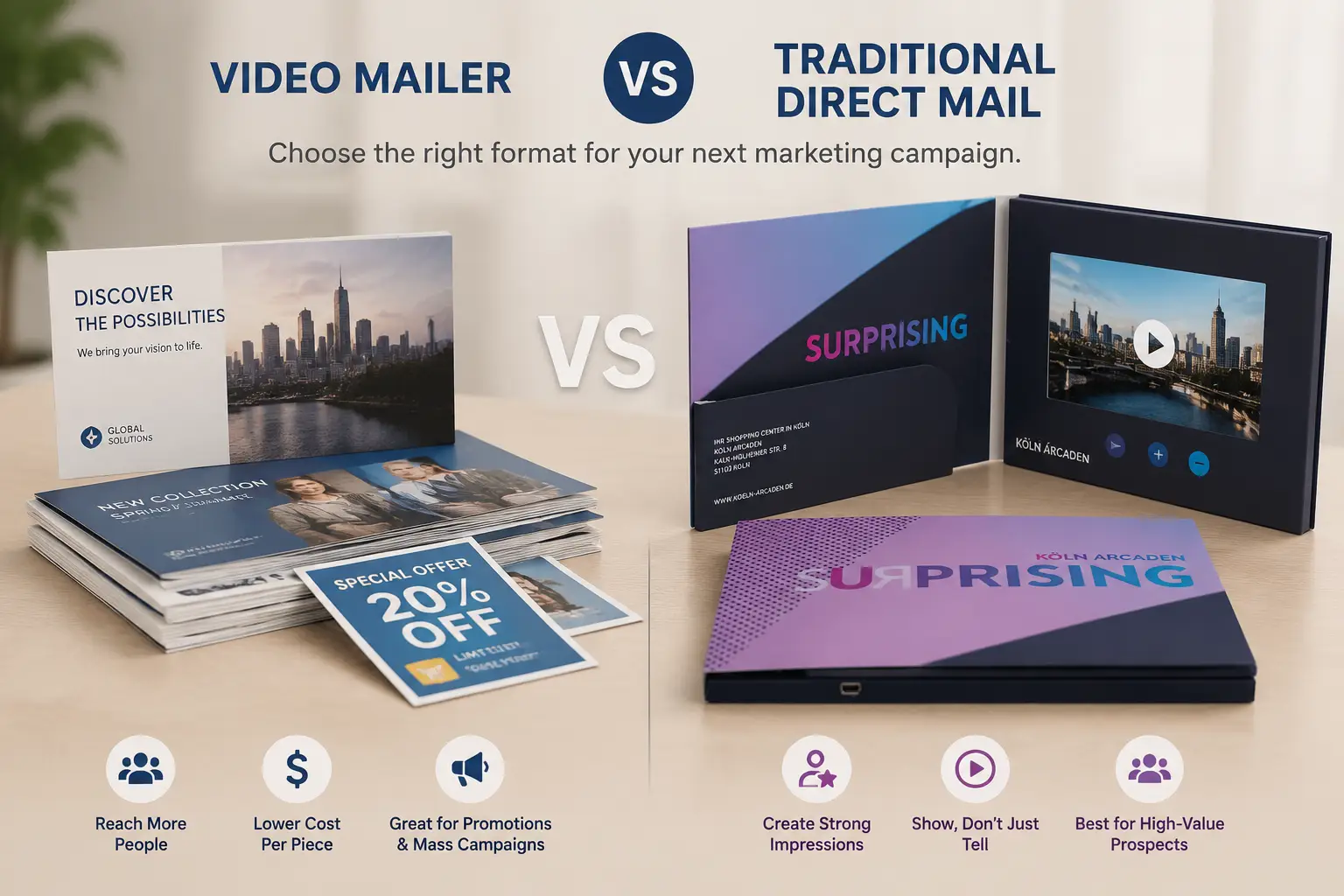
Choosing between a video mailer and traditional direct mail isn’t about selecting the newest marketing tool — it’s about choosing the right solution for your campaign.
In this guide, "traditional direct mail" refers to printed marketing materials such as postcards, brochures, catalogs, and flyers, rather than interactive formats like video mailers.
If your goal is to reach thousands of households with a simple promotional message, traditional direct mail remains one of the most cost-effective marketing channels available.
But if you’re trying to win a major account, launch a premium product, or impress a small group of decision-makers, investing in a video mailer may create a much stronger first impression.
Neither format is universally better. The right choice depends on your audience, campaign objectives, and the value of each opportunity.
This guide will help you decide which format best fits your next marketing campaign.
If you’re comparing cost alone, you’re asking the wrong question. This guide explains why.
Key Takeaways
Traditional direct mail is best for reaching large audiences at a lower cost.
Video mailers are best for engaging a smaller number of high-value prospects.
The right choice depends on campaign objectives — not simply budget.
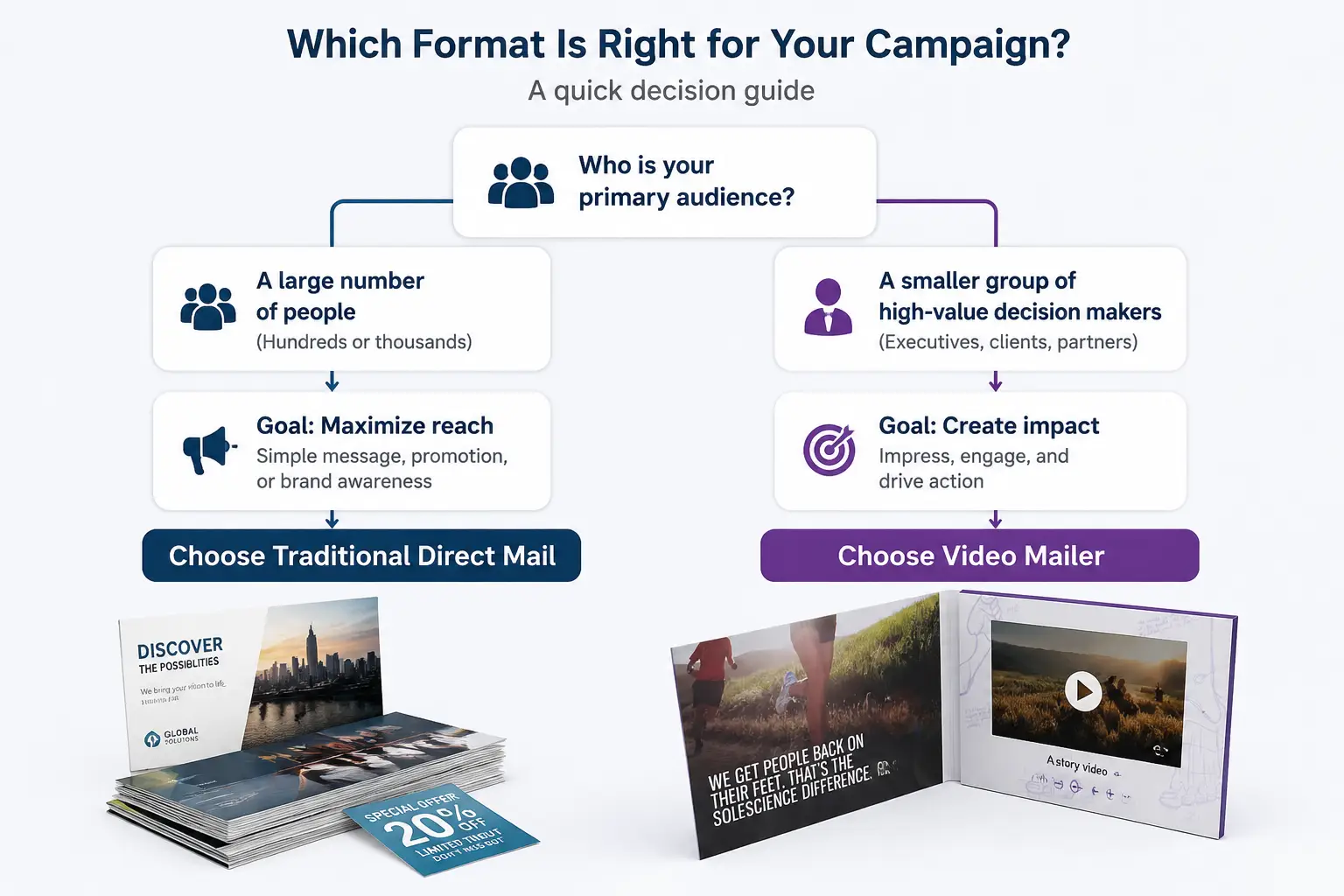
Quick Decision Guide
| If your campaign… | Choose |
|---|---|
| Targets thousands of recipients | Traditional Direct Mail |
| Needs to impress executives | Video Mailer |
| Requires product demonstration | Video Mailer |
| Focuses on coupons or promotions | Traditional Direct Mail |
Video Mailer vs Traditional Direct Mail
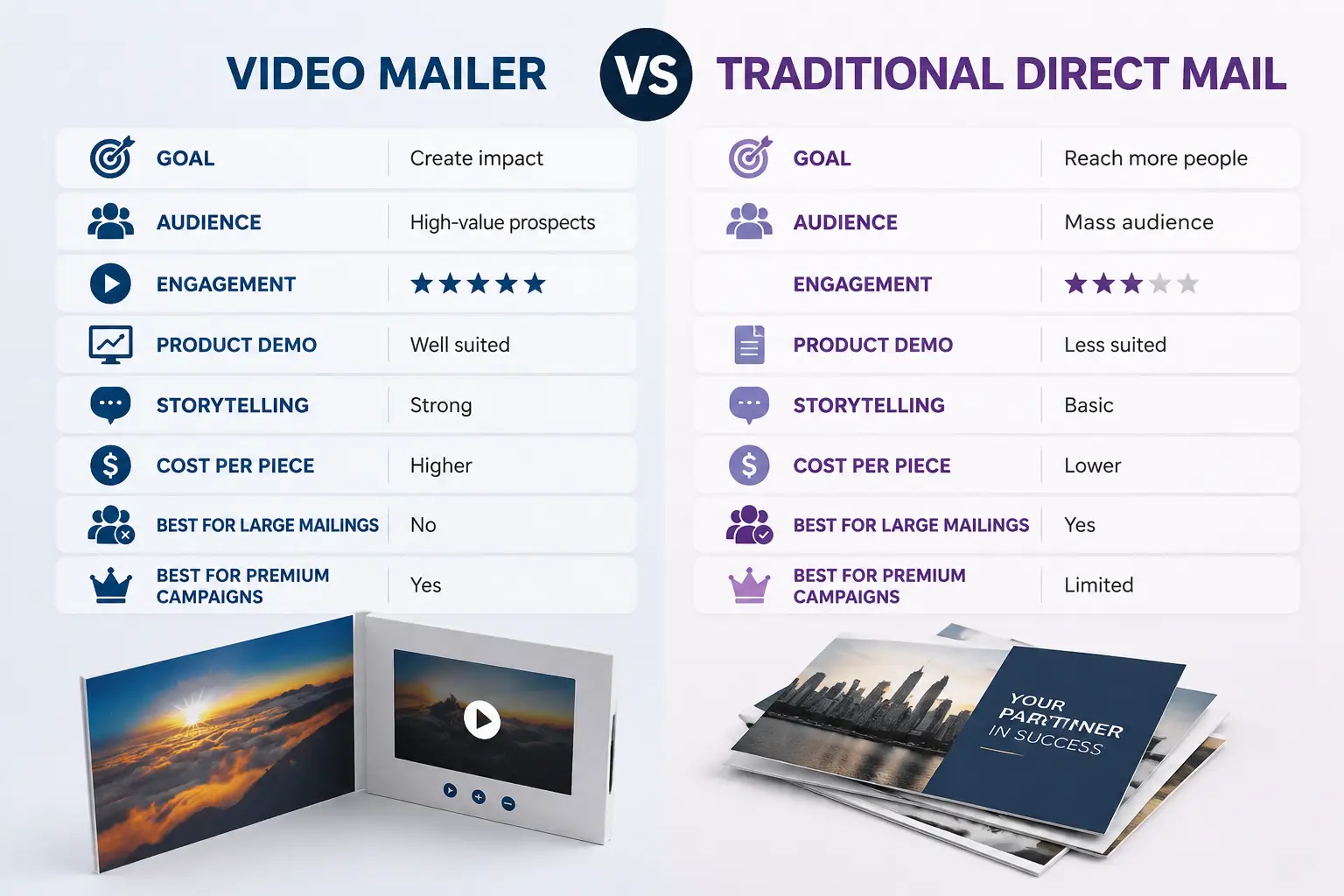
| Feature | Video Mailer | Traditional Direct Mail |
|---|---|---|
| Primary Goal | Create impact | Reach more people |
| Best Audience | High-value prospects | Mass audience |
| Product Demonstration | Well suited | Less suited |
| First Impression | Premium | Standard |
| Storytelling | Strong | Basic |
| Cost per Piece | Higher | Lower |
| Best for Large Mailings | No | Yes |
| Best for Premium Campaigns | Yes | Limited |
The biggest difference isn’t the technology — it’s the marketing strategy behind it. Traditional direct mail focuses on reach. Video mailers focus on engagement.¹
When Traditional Direct Mail Makes More Sense
Traditional direct mail continues to deliver excellent results for campaigns that require broad distribution at a controlled cost.
It is often the better choice for:
- Retail promotions
- Restaurant flyers
- Coupons
- Community marketing
- Every Door Direct Mail (EDDM)²
- Seasonal promotions
- Local brand awareness
If your message can be understood in a few seconds, printed direct mail is usually the most efficient option.
When a Video Mailer Is Worth the Investment
Video mailers are designed for situations where every recipient matters.
Instead of mailing thousands of people, companies typically send video mailers to a carefully selected audience that includes executives, investors, distributors, healthcare professionals, or property owners.
Typical applications include:
- Product launches
- Executive presentations
- Investor communications
- Luxury real estate
- Medical products
- High-value B2B sales
In our experience, customers rarely ask "What’s the cheapest video mailer?" More often, they ask whether a video mailer is the right tool for winning a specific customer, launching a product, or supporting an important presentation. That’s a very different question — and usually the more valuable one.
Rather than simply delivering information, a video mailer creates an experience that recipients are more likely to remember.
Real Project Example
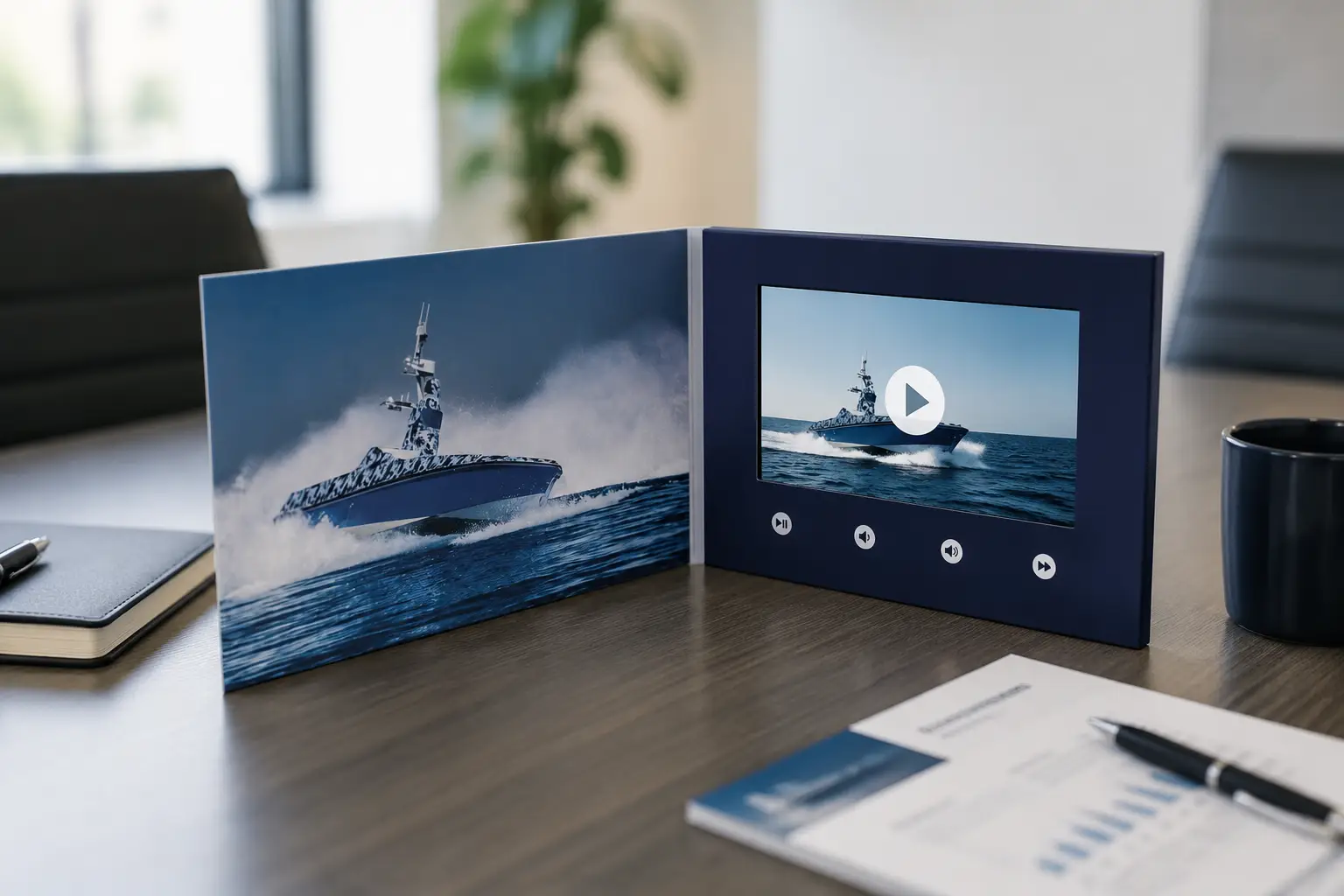
One of our customers chose custom video mailers for a corporate presentation instead of a large-scale direct mail campaign.
Rather than distributing thousands of printed brochures, they produced 300 custom 10.1-inch video brochures for key business partners and decision-makers.
For this campaign, creating a memorable presentation was more valuable than reaching a larger audience.
This illustrates an important point: the success of a video mailer campaign is usually measured by the quality of the conversations it creates—not the number of pieces mailed.
The Cost of Choosing the Wrong Format
Many marketers compare only the production cost. A better question is: what is the value of winning one customer?
Imagine two campaigns. Campaign A sends 20,000 printed postcards to local households. Campaign B sends 100 video mailers to carefully selected decision-makers.
The second campaign costs more per piece, but if one new customer represents a significant business opportunity, creating a memorable presentation may produce a much stronger return than reaching thousands of less-qualified prospects.
The most effective campaign isn’t always the least expensive one — it is the one that achieves the right business outcome.
Where Video Mailers Deliver the Most Value
Based on projects and customer inquiries we’ve handled since 2010, these are some of the industries where we’ve most frequently seen video mailers used.³
| Industry | Why Companies Choose Video Mailers |
|---|---|
| Real Estate | Listing presentations and luxury property marketing |
| Healthcare | Explain medical devices and healthcare services |
| Manufacturing | Demonstrate products and production capabilities |
| Corporate Sales | Executive presentations and account-based marketing |
| Fundraising | Deliver emotional stories that inspire donations |
| Education | Student recruitment and admissions campaigns |
These campaigns share one thing in common: each recipient is valuable enough to justify a more engaging presentation.
Common Mistakes When Choosing Direct Mail
- Choosing a marketing format before defining the campaign objective
- Choosing a video mailer simply because it looks impressive
- Using traditional direct mail to explain complex products
- Comparing unit cost instead of customer value
- Sending premium mailers to low-value audiences
- Focusing on the technology instead of the campaign goal
Five Questions Before Choosing
Before selecting either format, ask yourself these questions.
1. How valuable is each prospect?
The higher the value of each customer, the more worthwhile it becomes to invest in a premium presentation.
2. Does your product need a demonstration?
Complex products are often easier to explain through video than printed graphics.
3. Are you targeting hundreds or thousands of recipients?
Large mailing lists usually favor traditional direct mail, while highly targeted campaigns often benefit from video mailers.
4. Is making a strong first impression important?
Executives, investors, distributors, and premium clients often receive many marketing materials. Standing out can make a difference.
5. Will recipients keep the piece?
Premium presentation materials are more likely to remain on a desk or be shared with colleagues than standard flyers.⁴
Final Decision Checklist
Choose Traditional Direct Mail if you want to:
✓ Reach a large audience
✓ Promote coupons or seasonal offers
✓ Keep production costs low
✓ Build local brand awareness
✓ Deliver simple marketing messages
Choose a Video Mailer if you want to:
✓ Impress decision-makers
✓ Demonstrate products visually
✓ Launch premium products
✓ Support executive presentations
✓ Tell a compelling brand story
✓ Create memorable customer experiences
Neither format is inherently better. The best choice depends on your marketing goals — not simply your budget.
Frequently Asked Questions
| Question | Answer |
|---|---|
| Are video mailers considered direct mail? | Yes. A video mailer is a premium form of direct mail that combines printed materials with an embedded LCD screen and preloaded video content. |
| Can video mailers replace traditional direct mail? | No. Most companies use them for different purposes rather than treating one as a replacement for the other. |
| Can video mailers be mailed through USPS or other carriers? | Many video mailers can be designed to comply with applicable postal size and weight requirements. Whether a particular mailer qualifies depends on its dimensions, thickness, weight, and the mailing service you plan to use.⁵ |
| What industries use video mailers most often? | Video mailers are widely used in real estate, healthcare, manufacturing, corporate marketing, education, fundraising, and luxury product launches. |
| Are video mailers worth the additional investment? | They can be when every prospect represents significant business value. Rather than replacing traditional direct mail, video mailers are typically used for highly targeted campaigns where engagement matters more than reach. |
Final Recommendation
If your campaign succeeds because it reaches more people, choose traditional direct mail.
If your campaign succeeds because it persuades a small number of important people, choose a video mailer.
Neither approach is inherently better. The best choice depends on how your customers make decisions.
Need Help Choosing the Right Format?
Not every campaign needs a video mailer. If you tell us your audience, campaign goals, estimated quantity, and budget, we’ll recommend the solution that best fits your project — even if that means traditional direct mail is the better choice.
Discuss Your Campaign
Related Resources
- Video Mailer – Learn how video mailers work and available customization options.
- Real Estate Video Mailer – Discover how agents use video mailers to win listings.
- Video Brochure Cost – Compare screen sizes, quantities, and pricing factors.
- Video Brochure Manufacturer – Learn about our OEM manufacturing capabilities.
Footnotes
- "Reach" and "engagement" are used here as campaign objectives, not as a claim about specific response-rate benchmarks for either format.
- Every Door Direct Mail (EDDM) is a USPS program that allows mailers to reach every address on a carrier route without a mailing list.
- Industry categories reflect CheerTrend’s own order and inquiry history; this list is not an exhaustive market survey.
- This is a general observation about premium physical media, not a guaranteed outcome for any specific campaign.
- Postal and courier size/weight/thickness limits vary by service and by country; readers should confirm current requirements with their chosen carrier before finalizing mailer dimensions.
- Campaign suitability depends on factors such as audience size, budget, sales cycle, and marketing objectives. The examples in this guide are intended for general decision-making rather than guaranteed campaign outcomes.