

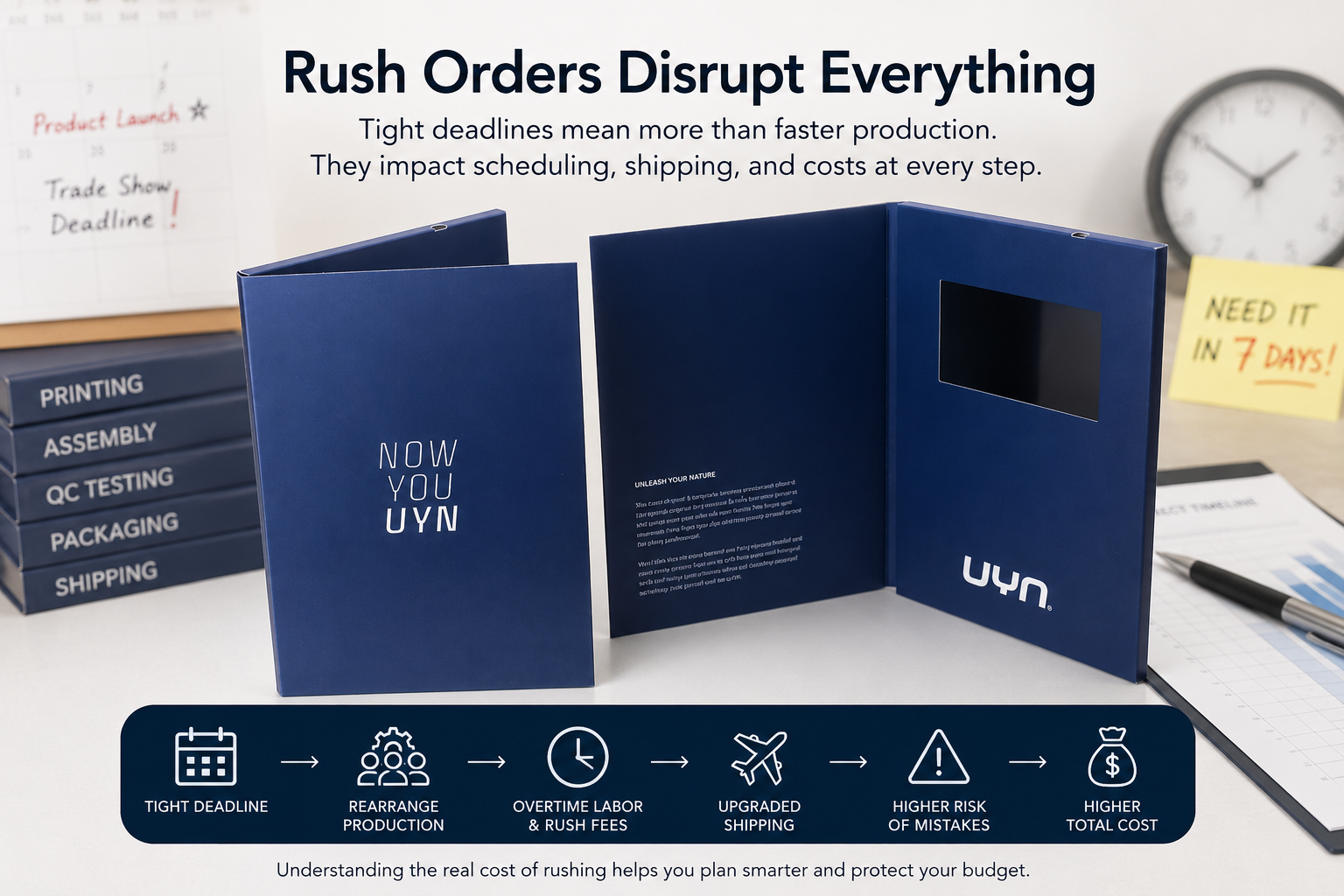
Many buyers think rush orders only cost more because factories charge extra. In reality, most rush-order costs come from disrupting the normal production system.
Rushing a video brochure order increases costs because factories must reorganize production schedules, source materials faster, upgrade shipping methods, and reduce normal production flexibility. Rush projects also carry higher QC and logistics risks.
I have worked on rush video brochure projects for trade shows, investor meetings, medical launches, luxury packaging, and product campaigns. Some urgent projects go smoothly. Others become expensive very quickly.
The difference usually comes down to preparation.
Why Rush Orders Disrupt Normal Production
Most buyers assume factories simply “work faster” for rush orders.
That is not what actually happens.
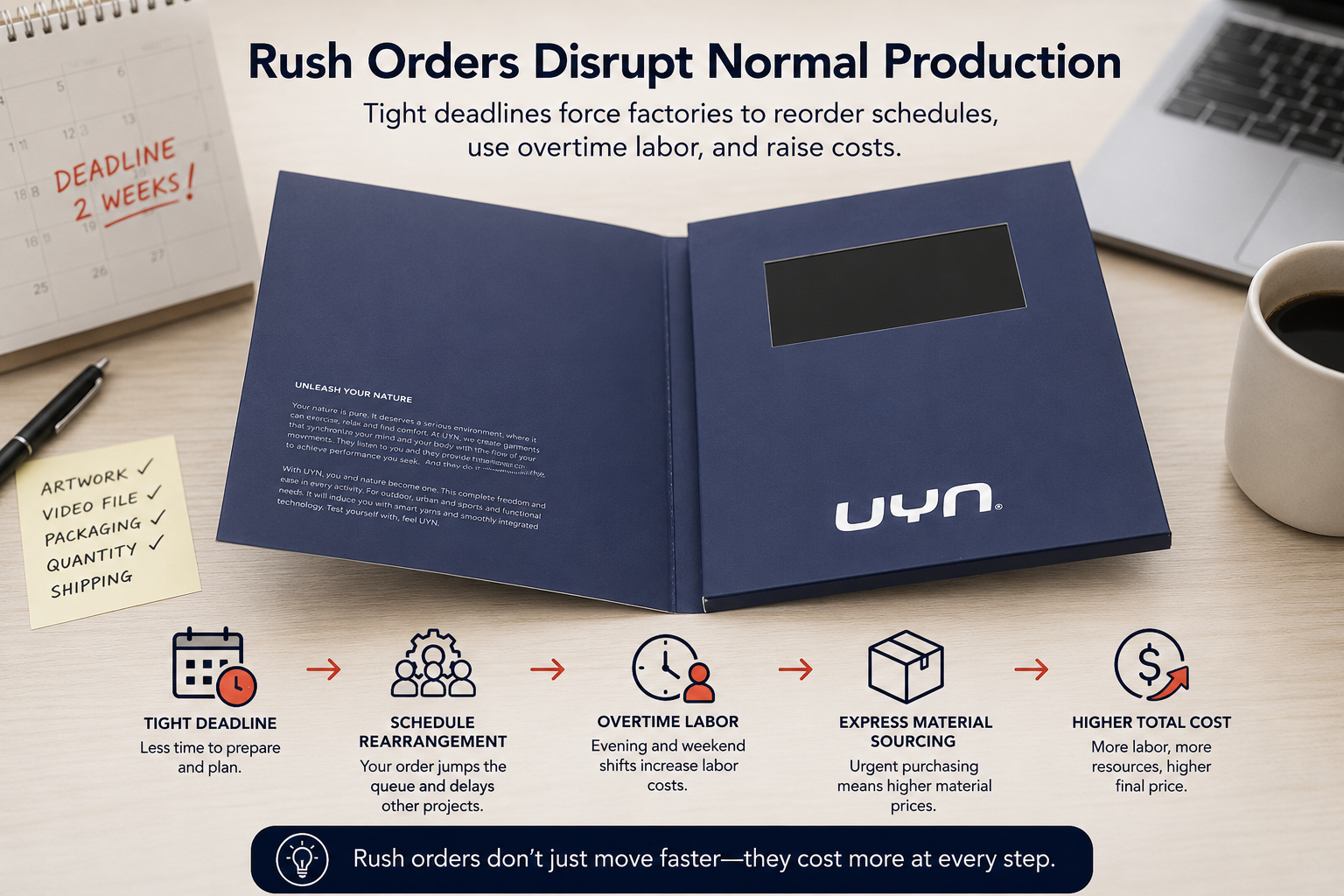
Rush orders usually force factories to:
- interrupt existing schedules
- delay other production jobs
- rearrange labor
- source materials faster
- prioritize assembly lines
In normal production, factories optimize workflow in batches.
For example:
- printing runs together
- foam inserts are cut together
- screens are assembled together
- packaging is scheduled in sequence
Rush orders break that rhythm.
Production Lines Cannot Instantly Expand
This is one of the biggest misunderstandings buyers have.
A factory cannot suddenly create:
- extra assembly lines
- extra QC staff
- extra packaging stations
Most video brochure factories already run close to full capacity during peak seasons.
When a rush order enters production, something else usually gets delayed.
That is why rush fees exist.
Factories Usually Hate Rush Orders
This part is rarely discussed openly.
Factories dislike rush projects because urgent orders disrupt production already scheduled weeks earlier.
A single emergency project can affect:
- staffing
- assembly flow
- packaging schedules
- shipment planning
Reliable factories calculate those risks carefully before accepting rush production.1
Unreliable suppliers simply say:
“No problem.”
Then the delays appear later.
Overtime Labor Increases Costs
Factories often need:
- evening shifts
- weekend production
- temporary workers
- overnight assembly
Those labor costs are real.
I once saw a client request a 7-day turnaround before CES. The factory completed the project, but production continued until almost midnight for several days straight.
The order shipped on time.
But the overtime cost alone was significant.
Small Rush Orders Can Be Surprisingly Expensive
Many buyers assume:
“It’s only 100 units.”
But small urgent orders can actually be harder to schedule than larger planned orders.
Why?
Because:
- setup time still exists
- QC still exists
- video loading still exists
- export paperwork still exists
The factory still needs to interrupt production flow for a relatively small batch.
Why Rush Shipping Changes Everything
For most serious video brochure projects, buyers already assume air freight from the beginning.
These products are usually tied to:
- launch events
- trade shows
- investor meetings
- medical campaigns
- luxury presentations
That means delivery timing matters more than saving freight costs.
The real decision is usually not:
air freight vs sea freight
It is:
standard air freight vs emergency express shipping
Standard Air Freight Is Usually The Normal Option
For most video brochure orders:
- standard air freight takes 7–12 days
- customs clearance is included
- delivery timing is relatively stable
Most experienced buyers already plan around this timeline.
Emergency Courier Shipping Gets Expensive Fast
Rush projects often require:
- DHL Express
- UPS priority shipping
- FedEx urgent delivery
- split shipments
Costs increase quickly during:
- Q4 holiday season
- CES preparation
- major product launch periods
During busy months, express air freight rates can increase 30–80% within a single week.2
Split Shipments Multiply Costs
This happens often when buyers approve projects too late.
Factories then ship:
- samples first
- partial production later
- remaining units separately
This helps protect the deadline.
But it also multiplies:
- freight charges
- customs paperwork
- handling costs
I have seen buyers nearly double freight spending simply because the project timeline became too compressed.
Rush Shipping Also Reduces Flexibility
Normal projects have more shipping options.
Rush projects usually do not.
Once the deadline becomes tight, buyers lose flexibility immediately.
At that point:
- the fastest route wins
- the cheapest route disappears
Why Rush Orders Increase Mistake Risks
This is the part many suppliers avoid discussing.
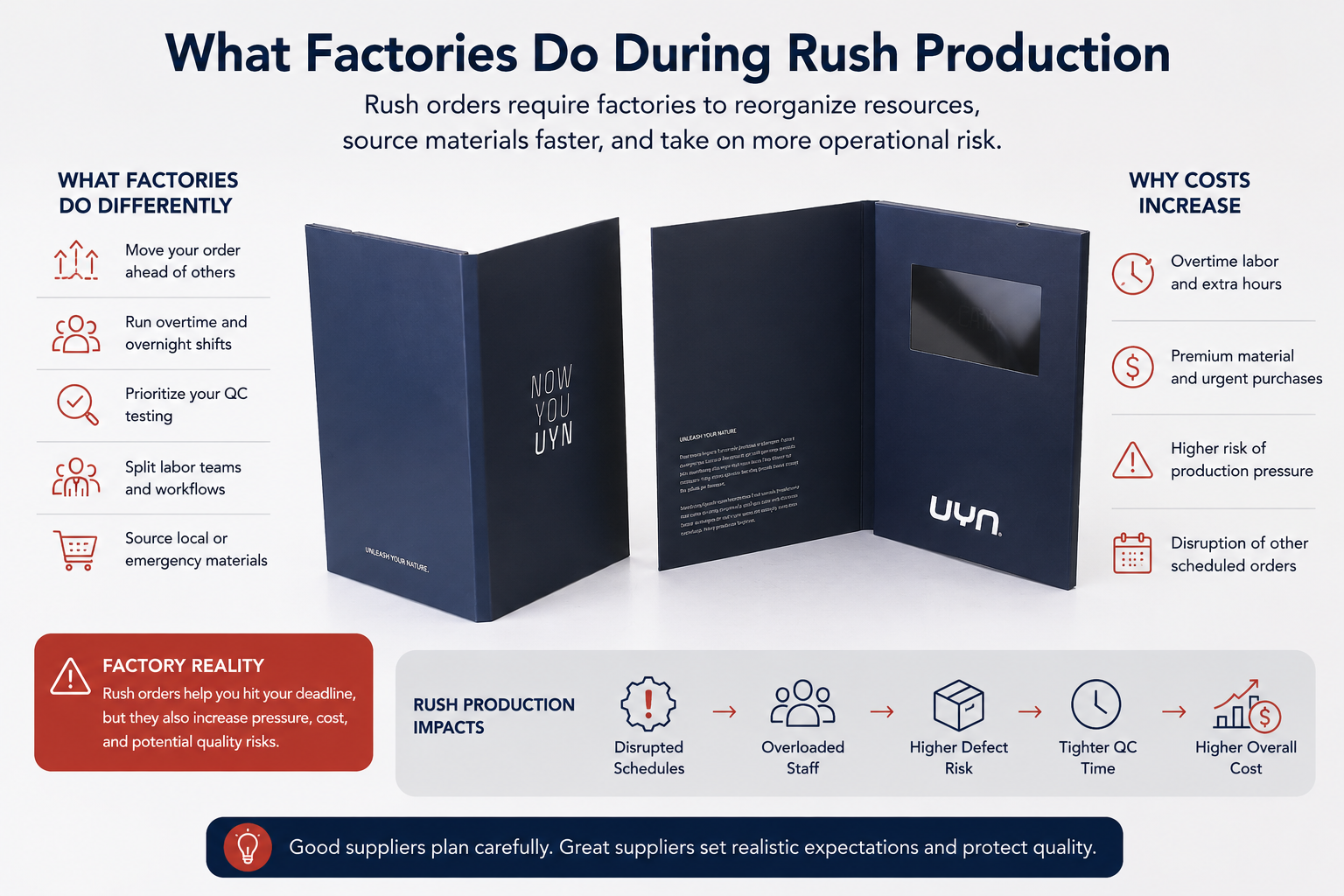
Rush orders carry a much higher risk of production mistakes.
When schedules become compressed, factories have less time for:
- QC testing
- playback verification
- print inspection
- packaging checks
- battery testing
Most factories try to maintain quality standards.
But time pressure changes everything.
Video Testing Gets Compressed
Normally, QC teams test:
- screen playback
- button functions
- charging
- speaker audio
- video looping
Rush production shortens testing windows.
That increases the chance of:
- incorrect video uploads
- frozen playback
- low battery charge
- button issues
Last-Minute File Changes Create Chaos
This happens constantly.
Buyers rush production, then continue changing:
- logos
- video files
- packaging details
- button functions
That combination creates production chaos.3
One client changed the final MP4 file after mass production had already started. The factory needed to reopen cartons and reload every unit manually.
The project still shipped.
But the labor cost increased significantly.
Rush Orders Remove Recovery Time
In normal production, factories still have time to fix:
- printing defects
- alignment problems
- packaging damage
Rush projects remove that safety buffer.
That means even small mistakes become expensive very quickly.
What Factories Actually Do During Rush Production
Many buyers never see what happens behind the scenes during urgent projects.
Factories often reorganize entire workflows to save a deadline.
During rush production, factories may:
- move your order ahead of others
- run overnight assembly
- prioritize your QC testing
- split labor teams
- source local emergency materials
All of that increases operating costs.
Material Sourcing Changes Completely
In normal production, factories optimize purchasing schedules.
Rush projects often require:
- local sourcing
- same-day purchasing
- emergency component orders
- premium material pricing
For example:
- batteries
- magnets
- rigid box materials
- foam inserts
may all require faster sourcing methods.
That increases costs immediately.
Factories Also Take On More Risk
When factories accept rush orders, they also risk:
- delaying other projects
- overloading staff
- increasing defect rates
- creating scheduling conflicts
Reliable factories understand this clearly.
That is why experienced suppliers sometimes reject unrealistic deadlines completely.4
Ironically, factories that say “yes” to everything often become the least reliable suppliers later.
When Rush Orders Are Actually Worth It
Not every rush order is a bad decision.
Sometimes paying more is completely justified.
Rush production can make sense for:
- investor presentations
- trade shows
- product launches
- media campaigns
- luxury client events
Missing those deadlines may cost far more than rush production itself.
The Real Cost Is Often Missing The Event
I always tell buyers this:
The biggest cost is usually not the rush fee.
It is missing the opportunity.
If a video brochure arrives after:
- CES
- an investor pitch
- a product launch
its marketing value drops dramatically.
Rush Orders Work Best When Files Are Already Ready
The smoothest rush projects usually happen when buyers already have:
- approved artwork
- finalized videos
- confirmed quantities
- shipping addresses
Projects become much riskier when buyers rush production while still making revisions.
That combination almost always creates problems.
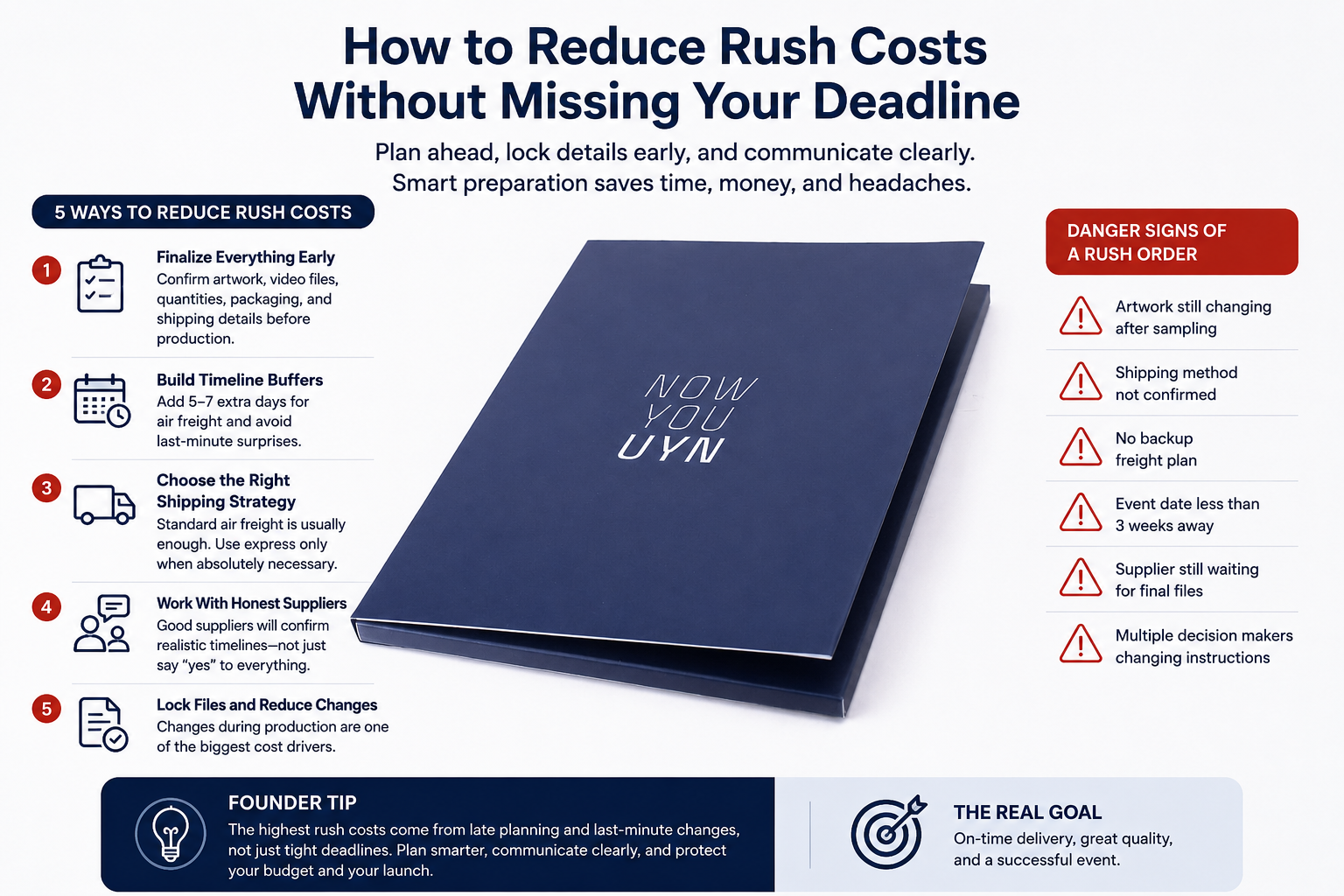
How To Reduce Rush Costs Without Missing Your Deadline
Many rush-order costs are preventable.
The best way to reduce costs is to prepare earlier and reduce production uncertainty.
Signs Your Project Is Becoming A Dangerous Rush Order
Experienced buyers usually notice warning signs early.
Common danger signals include:
- artwork still changing after sampling
- shipping method not confirmed
- no backup freight plan
- event date less than 3 weeks away
- supplier still waiting for final video files
- multiple decision makers changing instructions
When several of these problems happen together, costs usually rise very quickly.
Finalize Everything Before Production Starts
Before placing the order, confirm:
- artwork
- video files
- screen size
- packaging structure
- button functions
- shipping method
Mid-production changes are one of the fastest ways to increase costs.
Build Timeline Buffers Into Every Project
I usually recommend:
- adding 5–7 extra days for air freight projects
- avoiding “exact deadline” scheduling completely
Unexpected delays always happen:
- customs inspections
- holiday slowdowns
- battery paperwork
- freight congestion
The buyers who avoid rush fees usually start earlier than they think necessary.
Work With Suppliers That Discuss Scheduling Honestly
Reliable suppliers usually ask:
- your event date
- shipping destination
- customization level
- packaging requirements
before confirming production timelines.
That is a good sign.
Suppliers that immediately promise:
“5-day turnaround no problem”
without reviewing files are usually guessing, not planning.
Use Faster Shipping Instead Of Compressing Production
Sometimes the smarter solution is:
- normal production speed
- faster delivery service
instead of compressing the entire factory schedule.
That usually reduces:
- QC risk
- overtime costs
- production mistakes
while still protecting the launch date.
Conclusion
Rush video brochure orders cost more because they disrupt normal production, increase freight costs, compress QC time, and create higher operational risks.
In my experience, the buyers who pay the highest rush costs are usually not the buyers with the tightest deadlines.
They are the buyers who start late, keep changing files, and expect production to move faster without reducing project complexity.
The smoothest projects are not necessarily the slowest ones.
They are the projects that lock decisions early, communicate clearly, and leave enough buffer before the launch date.
-
Most video brochure factories schedule production 1–3 weeks in advance during peak seasons, especially before major trade shows and Q4 campaigns. ↩
-
Express air freight pricing often fluctuates heavily during October–January due to holiday demand and electronics shipment volume. ↩
-
Reopening packaged units for video reloading increases labor time, QC workload, and packaging damage risk. ↩
-
Experienced suppliers sometimes reject unrealistic rush deadlines to protect QC stability and avoid production bottlenecks.