

Most buyers think video brochure production starts after payment. In reality, delays usually begin long before assembly.
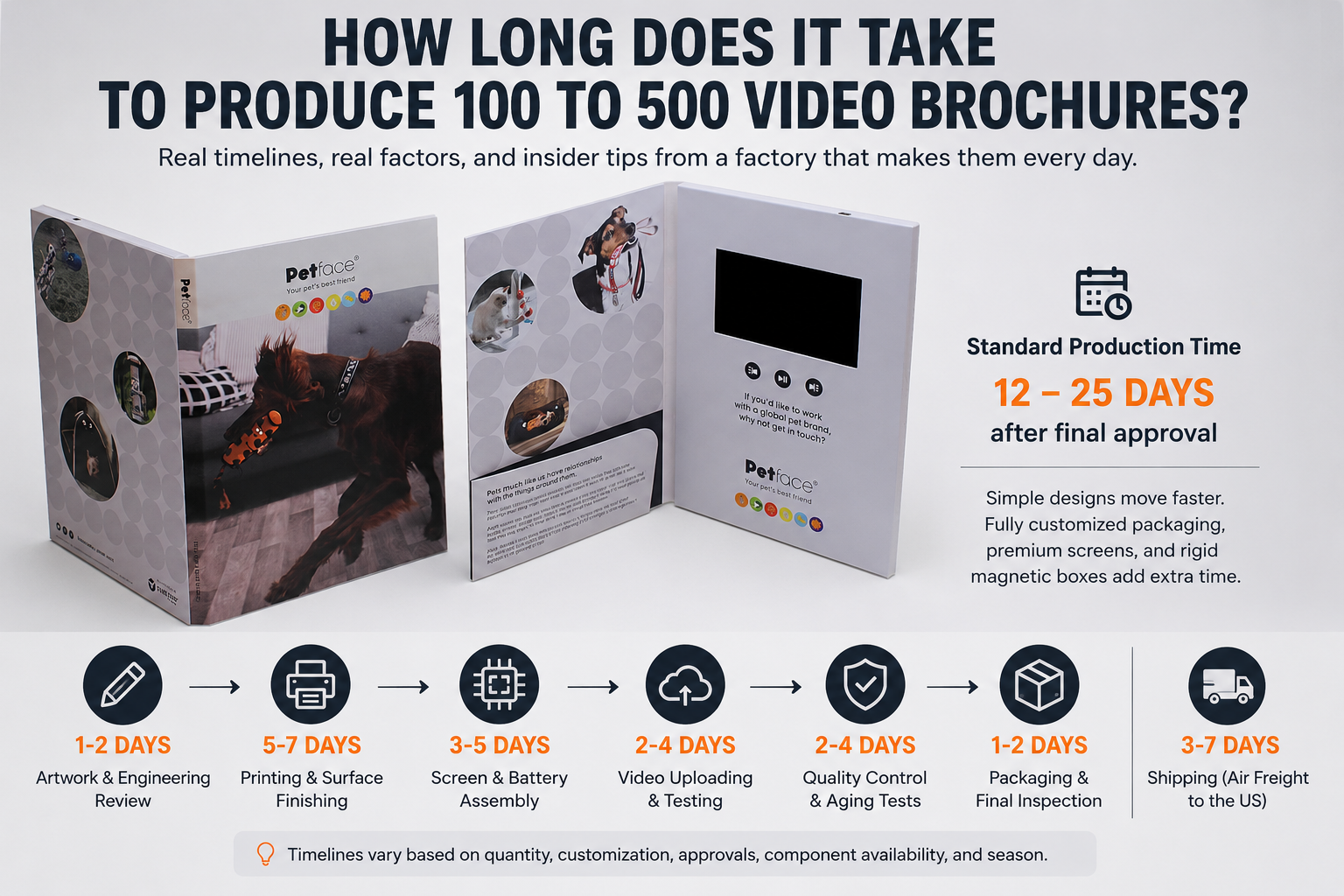
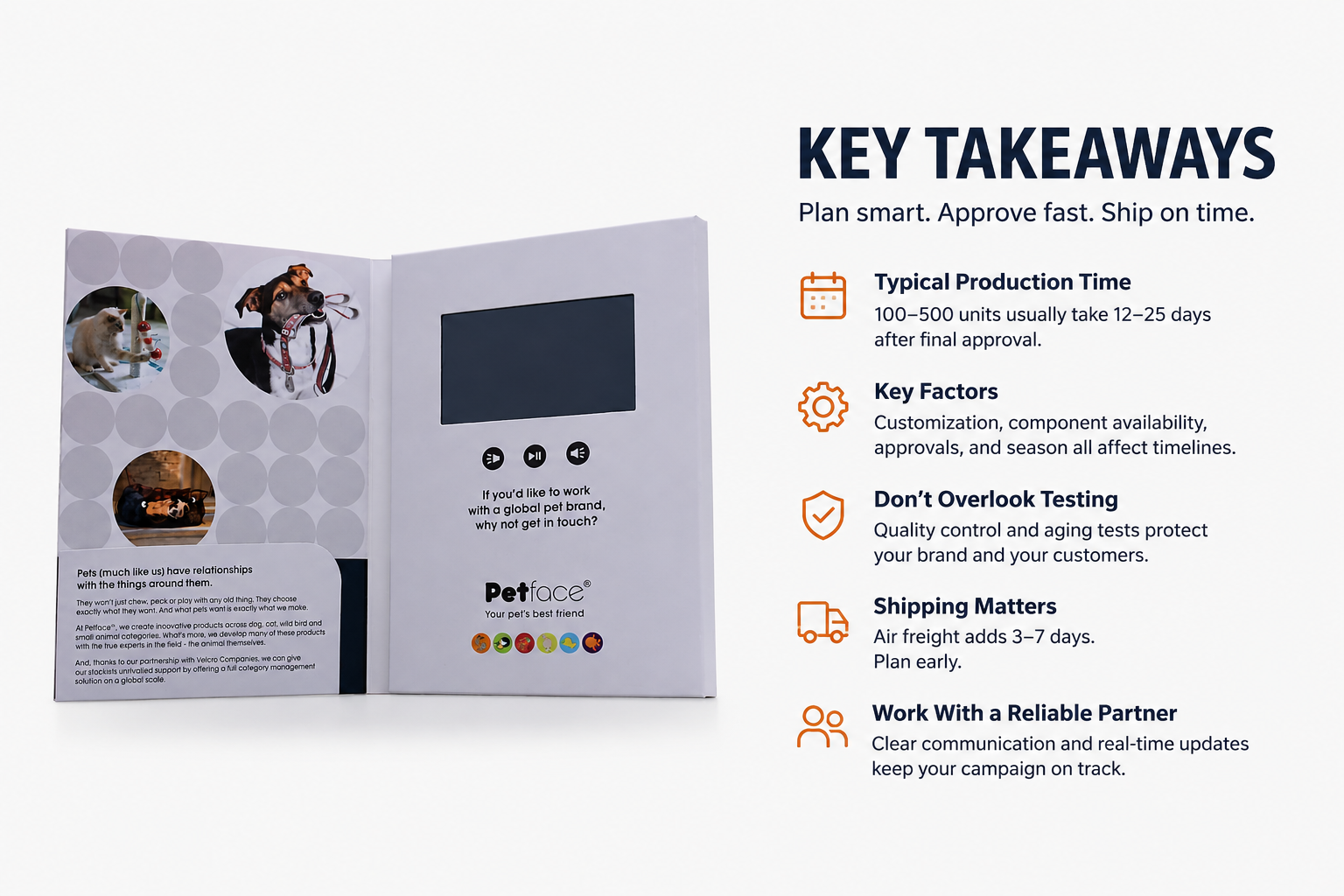
For 100 to 500 units, standard video brochure production usually takes 12 to 25 days after final approval. Simple brochure designs move faster. Fully customized packaging, premium screens, and rigid magnetic boxes add extra time.
Many suppliers only quote assembly time. But real production also includes printing, screen sourcing, video loading, battery testing, quality control, and shipping coordination. That is where most timelines change.
What Is the Average Production Timeline?
Many buyers ask for lead times before artwork is finalized. But approval speed usually affects the schedule more than factory capacity.
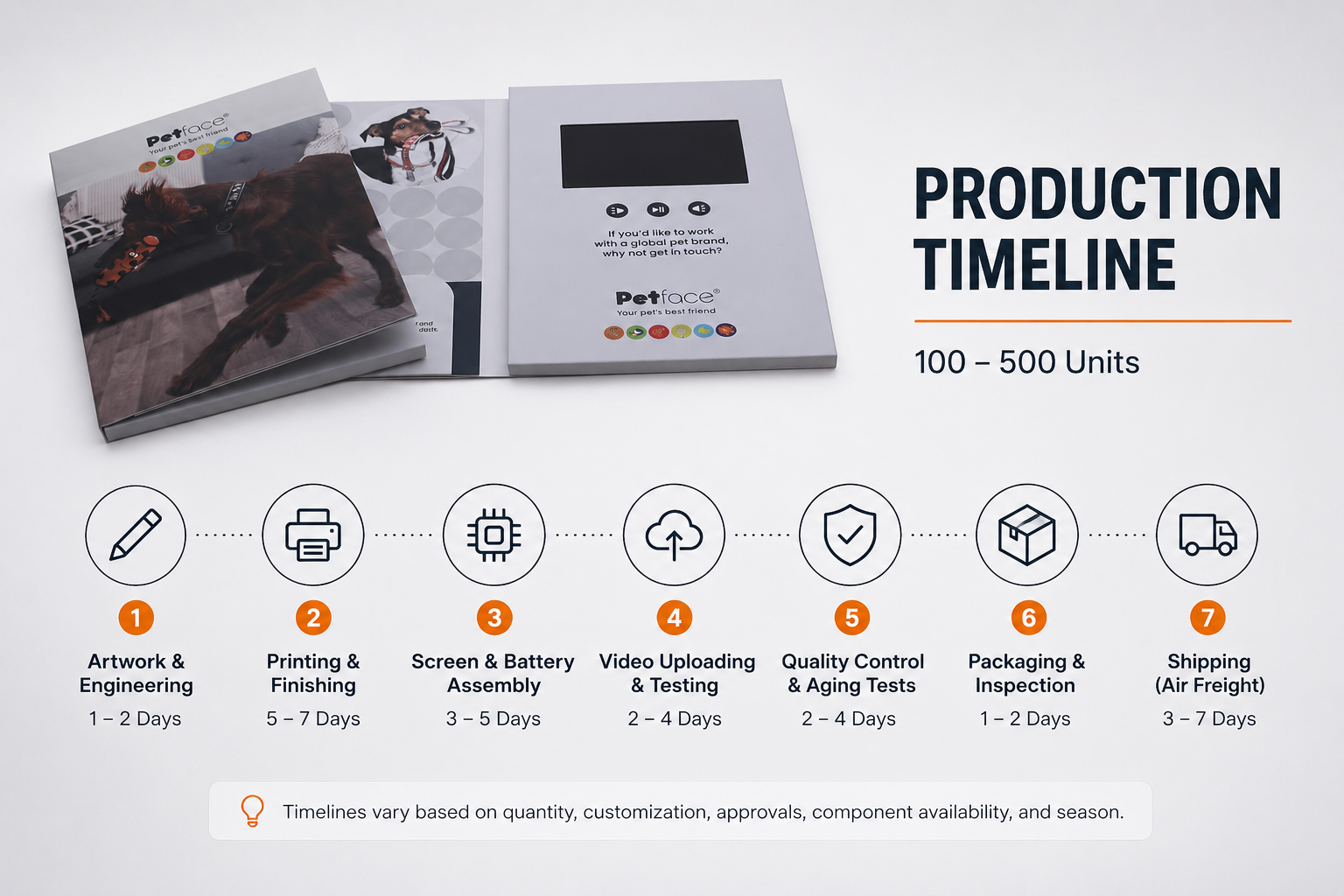
For standard orders between 100 and 500 units, this is the realistic timeline range I usually see:
| Quantity | Standard Production | Rush Production |
|---|---|---|
| 100 units | 10–14 days | 7–10 days |
| 300 units | 12–18 days | 8–12 days |
| 500 units | 15–25 days | 10–15 days |
These timelines normally include:
- printing
- screen assembly
- battery installation
- video loading
- testing
- packaging
Shipping is separate.
Air freight from China to the United States usually adds another 3 to 7 days. Sea freight takes much longer and is rarely practical for smaller campaign quantities.1
Why Small Orders Sometimes Move Faster
Many people assume factories prefer larger orders. That is only partially true.
A 100-unit order often moves faster because:
- manual assembly is easier
- QC is quicker
- video uploading takes less time
- packaging volume is lower
But highly customized small projects can still become slow if they require:
- special screen sourcing
- custom foam inserts
- rigid presentation boxes
- non-standard printing
I once saw a project lose nearly a week because the client changed a QR code after printing had already started. Small revisions create larger production interruptions than many buyers expect.
When Does Production Actually Start?
Many buyers think factories start production immediately after payment.
That almost never happens.
Most factories start after:
- artwork approval
- video confirmation
- technical specification approval
- screen specification confirmation
This detail matters more than most buyers realize.
I have seen buyers approve a design on Friday and expect production to start Monday. But if the factory suddenly runs short on 7-inch IPS screens because inventory was allocated to another large project overnight, the schedule can immediately shift by another 7 to 10 days.
Not because of printing.
Not because of assembly.
Because of one component nobody confirmed early enough.
Why Screen Availability Matters
Video brochures are still electronic products.
That means production depends on:
- LCD inventory
- battery supply
- PCB availability
- memory chip stock
During busy Q4 periods, certain screen sizes become temporarily harder to source, especially:
- IPS screens
- ultra-thin displays
- high-brightness screens
At CheerTrend, we usually recommend locking screen specifications before final artwork approval because component sourcing changes quickly during peak season.2
What Actually Happens During Video Brochure Production?
Many buyers imagine video brochures as simple printed products. In reality, they combine packaging manufacturing with electronics assembly.
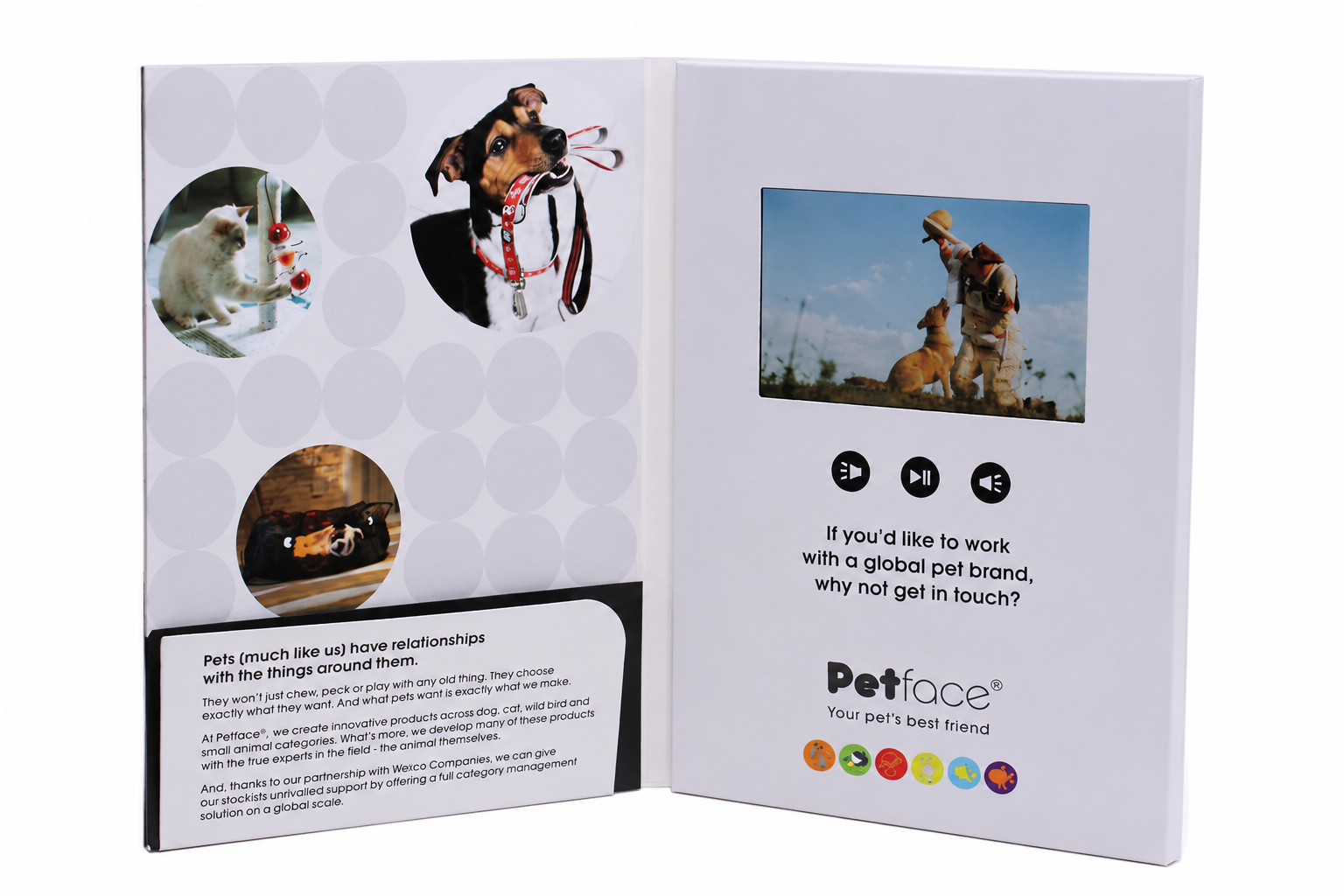
A normal production workflow involves several departments working simultaneously.
Step 1: Artwork and Engineering Review
The factory checks:
- dielines
- fold structure
- button placement
- speaker holes
- screen positioning
- battery spacing
This stage normally takes 1 to 2 days.
Magnetic closures and rigid gift boxes usually require additional engineering checks because alignment affects assembly consistency.
Step 2: Printing and Surface Finishing
This stage usually takes 5 to 7 days.
The printed sheets go through:
- CMYK printing
- lamination
- foil stamping
- spot UV
- die cutting
Printing queues delay more projects than electronics assembly during peak season.
Many buyers assume electronics are the biggest bottleneck. But during Q4, printing queues often become slower than assembly itself.
Step 3: LCD Screen and Battery Assembly
Workers install:
- LCD screen
- rechargeable battery
- PCB board
- speaker
- USB charging port
- control buttons
For quantities between 100 and 500 units, many factories still rely on partial manual assembly.
That is why button quantity directly affects production speed.
| Configuration | Production Complexity |
|---|---|
| Auto-play only | Fast |
| 2–3 buttons | Medium |
| 5–6 navigation buttons | Slower manual assembly |
Step 4: Video Uploading
This stage sounds simple, but it becomes a hidden bottleneck very quickly.
Every unit requires:
- file upload
- playback verification
- synchronization testing
- memory check
For 500-unit projects, uploading and testing videos manually can take much longer than buyers expect.3
Step 5: Quality Control and Dual Aging Tests
Professional factories normally test:
- charging performance
- playback stability
- speaker volume
- button response
- battery consistency
Good factories usually perform:
- module aging tests before assembly
- finished product aging tests after assembly
Some suppliers skip extended testing to shorten lead times.
I always recommend buyers ask specifically about battery aging procedures because hidden battery issues usually appear during extended testing, not during quick inspections.
Why Do Different Suppliers Quote Different Lead Times?
Many buyers get confused when one supplier quotes 12 days and another quotes 30 days.
Usually, both are technically correct.
They are simply calculating production differently.
| Factor | Faster Timeline | Slower Timeline |
|---|---|---|
| Supplier type | Direct factory | Trading company |
| Brochure structure | Stock shell | Fully customized |
| Quote scope | Assembly only | Full production |
| Testing process | Limited QC | Dual aging tests |
| Material inventory | Stock components | Custom sourcing |
The Truth About “7-Day Production”
Most 7-day production claims rely on stock materials and simplified structures.
Real 7-day production usually only works when:
- stock materials already exist
- standard brochure sizes are used
- artwork is finalized immediately
- simple packaging is selected
A supplier promising extremely fast production may be:
- skipping extended testing
- using semi-finished stock shells
- excluding printing time
- excluding sourcing time
That does not always mean the supplier is dishonest. But buyers should understand exactly what is included in the timeline.
How Does Customization Affect Production Time?
Customization creates the biggest difference between a 12-day project and a 30-day project.
Simple brochure designs move quickly because factories already have:
- tooling
- production experience
- standard assembly methods
- packaging templates
Fastest Production Options
These features usually move fastest:
- standard brochure sizes
- auto-play setup
- matte lamination
- standard LCD screens
- simple fold structures
Slower Premium Options
| Feature | Additional Production Time |
|---|---|
| Magnetic gift box | 2–4 days |
| Custom foam insert | 2–3 days |
| Foil stamping | 1–2 days |
| Multi-button controls | 1–3 days |
| Custom die-cut structure | 3–5 days |
Many buyers focus only on appearance. But every customization increases production complexity somewhere in the workflow.4
At CheerTrend, we often recommend a sample-first workflow for premium presentation kits because foam inserts, magnetic closures, and rigid structures can affect assembly timing later.
Conclusion
Most orders for 100 to 500 video brochures take around 2 to 4 weeks to produce. But preparation quality, customization complexity, and approval speed usually affect timelines far more than buyers expect.
Factories rarely delay projects on purpose. Most delays come from revisions, sourcing changes, and unrealistic scheduling expectations.
-
Air freight timelines vary depending on customs clearance, carrier capacity, and destination region. ↩
-
IPS screen availability often fluctuates during peak export seasons and large electronics procurement cycles. ↩
-
Large video files and multi-language content increase upload and testing time significantly for mid-sized production runs. ↩
-
Premium packaging structures require more manual assembly and alignment checks than standard brochure formats.