

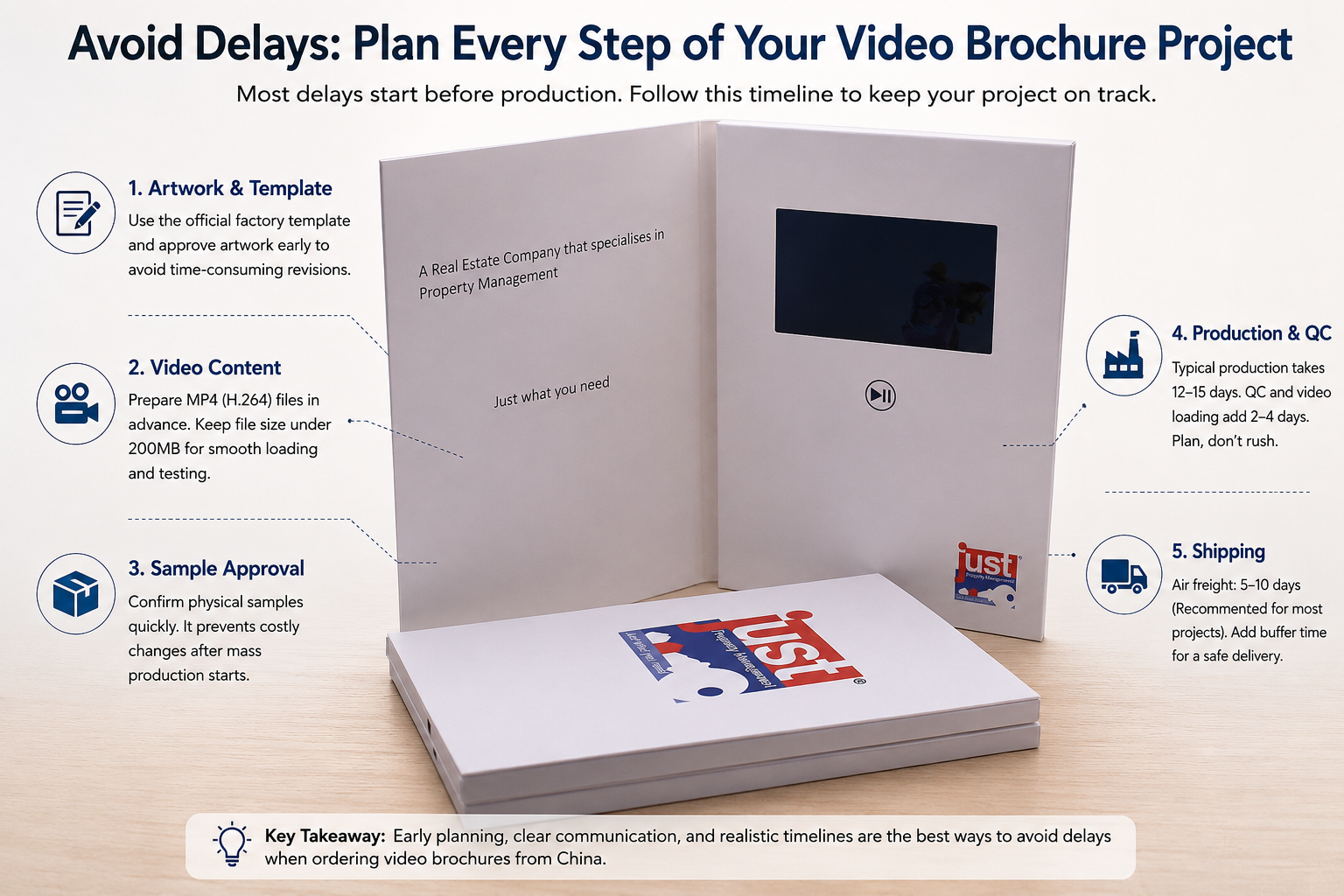
Many video brochure projects miss launch dates because buyers underestimate approval timelines, production complexity, and freight lead times. Most delays actually start before factory production begins.
Video brochure orders from China avoid delays when buyers finalize artwork early, lock specifications before sampling, prepare video files in advance, and leave enough shipping buffer. Most production problems come from repeated revisions, unclear communication, and unrealistic delivery expectations.
I have worked on video brochure projects for trade shows, medical campaigns, luxury packaging, investor kits, and product launches. In most cases, the factory is not the biggest problem. Delays usually happen during approvals, revisions, freight booking, or last-minute changes.
Many buyers think video brochures work like normal printing projects.
They do not.
A video brochure combines:
- printing
- electronics
- lithium batteries
- firmware testing
- packaging
- international logistics
That means even a small revision can affect multiple production stages at the same time.
Why Do Video Brochure Orders Usually Get Delayed?
Many buyers think production delays happen inside the factory. In reality, most problems start much earlier.
Video brochure orders usually get delayed because of unfinished artwork, incorrect templates, repeated revisions, late video files, overloaded production schedules, and unrealistic launch expectations.
I noticed many first-time buyers focus heavily on brochure design but underestimate production coordination.
That usually creates problems later.
Artwork Revisions Slow Everything Down
This is the most common issue I see.
Many buyers start designing before requesting the official factory template. Later they discover:
- button holes do not align
- folds cover the screen area
- bleed sizes are incorrect
- foam thickness changes the layout
- charging ports interfere with the design
Then the artwork needs rebuilding.
Some buyers also keep changing:
- logo size
- box dimensions
- screen position
- print finishes
- memory size
Every revision resets part of the workflow.
If the button position changes by only a few millimeters, the internal PCB alignment may also need adjustment.
Most factories do not explain this clearly before production starts.1
One client approved artwork on Friday and changed the screen size on Monday. That single change delayed the project by almost 10 days because the foam insert and PCB layout both needed rebuilding.
Video Files Create Hidden Delays
This part surprises many clients.
Some teams spend weeks approving the brochure design but only think about the video content near the shipping date.
Then we receive:
- oversized MP4 files
- unsupported resolutions
- unfinished edits
- damaged files
- incorrect aspect ratios
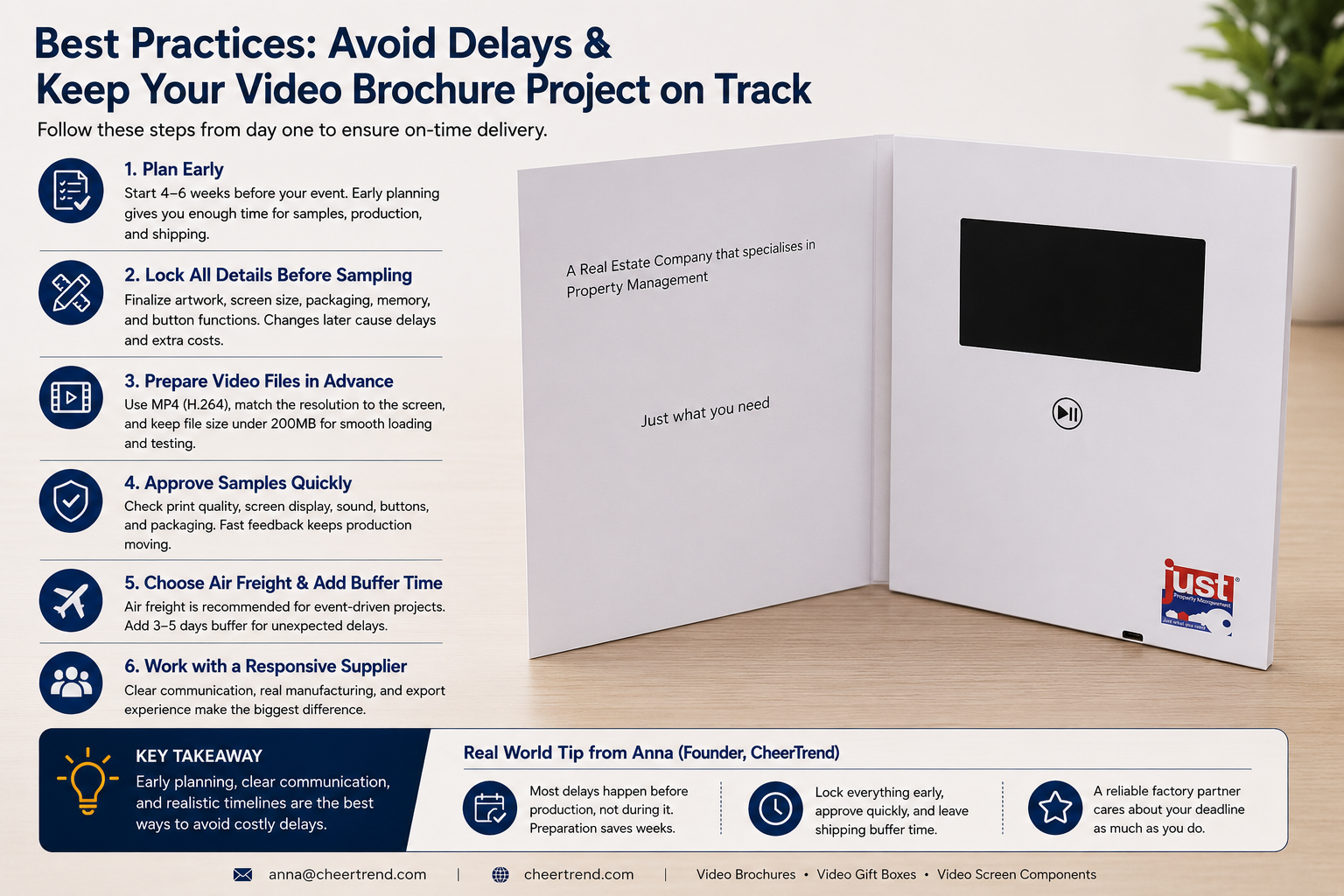
We usually recommend:
- MP4 format
- H.264 encoding
- file sizes under 200MB per video
- resolution matched to screen size
For example, a 7-inch IPS screen usually works perfectly with 1024×600 resolution. A huge 4K file only increases loading and testing time without improving playback quality.
Files larger than 500MB also slow down batch loading and playback testing significantly.
Large Orders Can Delay Smaller Projects
Many buyers assume small orders move faster.
That is not always true.
If a factory is already running a 5,000–10,000 unit production batch, smaller jobs may wait in queue because one production line can only handle one major assembly batch at a time.
I have seen 100-unit orders move slower than 2,000-unit orders during peak season.
Holiday Production Bottlenecks Are Real
Chinese holidays affect:
- labor availability
- battery supply
- print material sourcing
- freight capacity
Before Chinese New Year, some suppliers stop accepting new production orders 2–3 weeks early.2
October through January is usually the busiest season for video brochure factories because of holiday campaigns, CES preparation, and annual marketing events.
When Should You Finalize Artwork And Video Files?
Many delays happen because buyers treat artwork and video preparation as separate tasks.
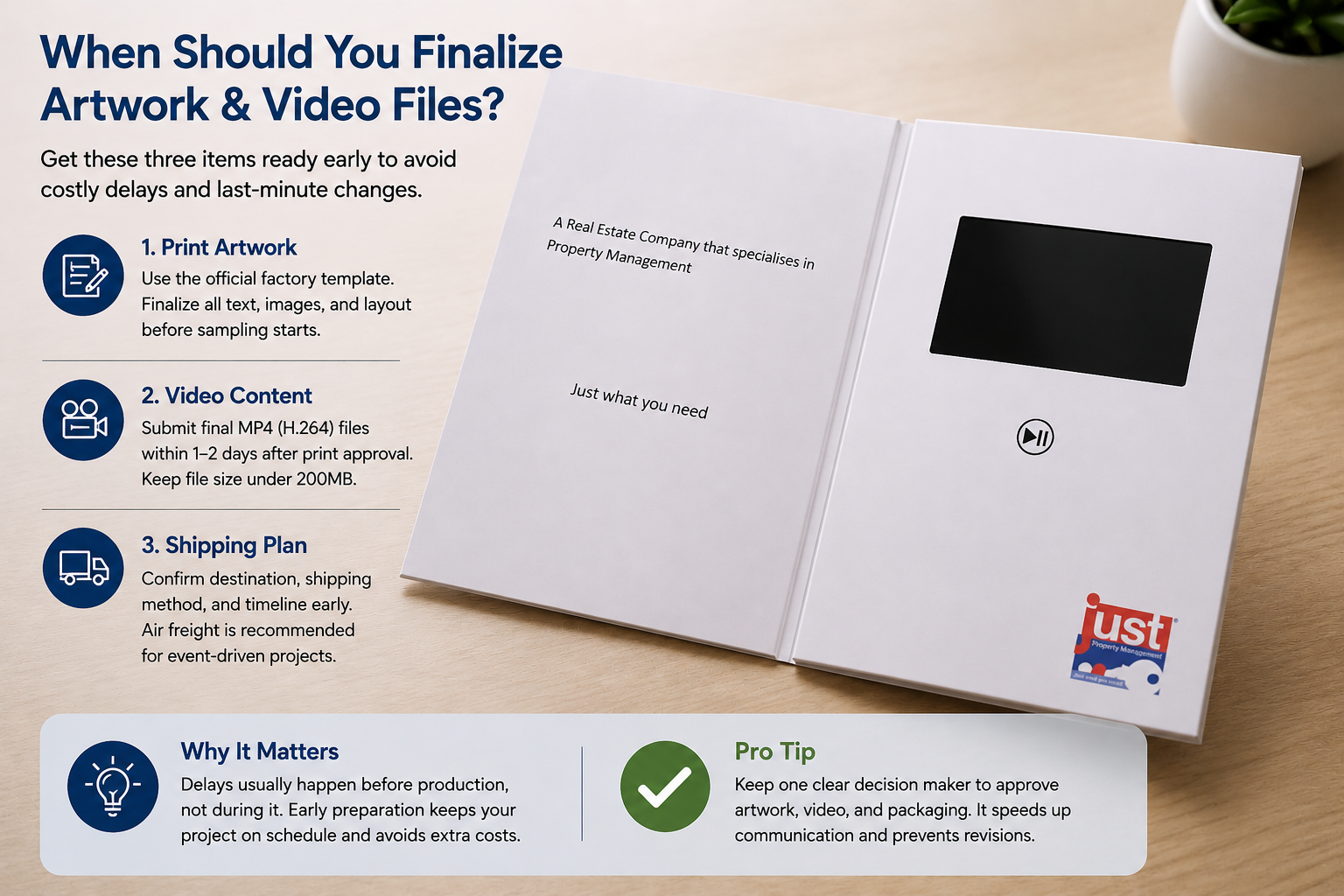
Buyers should finalize artwork before sampling starts and submit final video files within 1–2 days after print approval. Waiting until mass production begins usually creates unnecessary delays.
I usually tell clients to prepare three things together:
- print artwork
- video content
- shipping plan
Projects move much faster when all three are ready early.
Always Use The Official Factory Template
Every supplier uses slightly different:
- hinge structures
- screen openings
- button layouts
- foam thickness
- magnetic closures
Never build artwork without the final dieline template.
I once saw a client redesign an entire luxury presentation box because the original artwork ignored the internal battery position. That mistake delayed the launch by almost two weeks.
Factories that cannot provide proper templates quickly are often not actual manufacturers.
In many cases, they are trading companies outsourcing production elsewhere.
Physical Samples Save Time Later
Some buyers skip samples because they want faster delivery.
Ironically, that often creates bigger delays during mass production.
A sample helps verify:
- print colors
- screen brightness
- button functions
- fold positions
- packaging quality
- charging ports
- video playback
Finding these issues after mass production starts is much more expensive and time-consuming.
Avoid Mid-Production Changes
Once assembly starts, changing:
- screen size
- packaging structure
- print finish
- memory capacity
- button configuration
can restart sourcing and assembly preparation.3
I see this constantly on Alibaba. Some suppliers promise 5-day production before they even review the artwork files.
That is usually guessing, not actual production planning.
How Long Does Video Brochure Production Really Take?
Many suppliers advertise unrealistic production timelines to secure orders quickly.
For video brochures, sea freight is rarely used because these are high-value, time-sensitive products for trade shows, product launches, and marketing campaigns. Air freight is usually the standard shipping method.
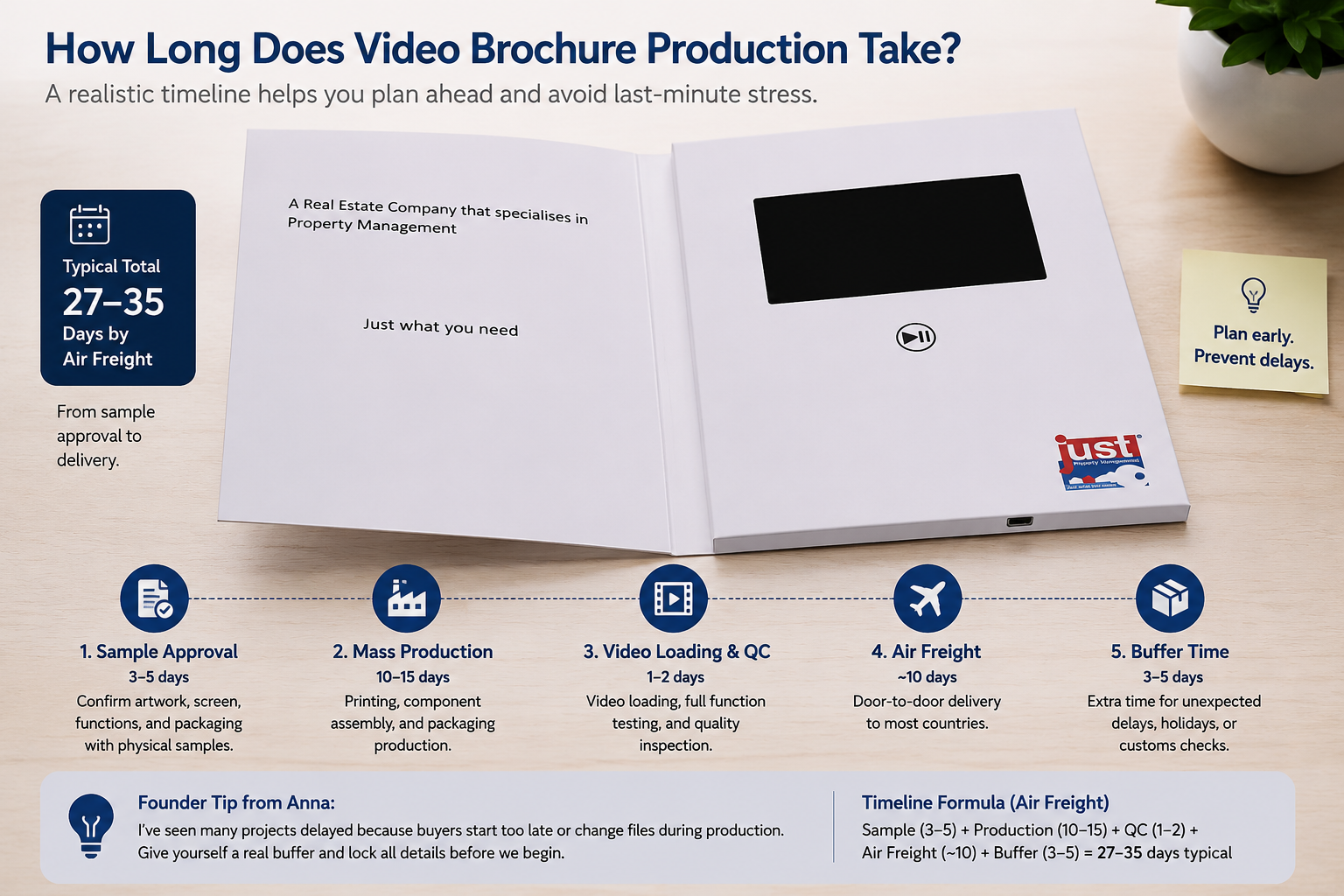
Realistic Timeline Formula
Based on actual production experience, here is a realistic timeline calculation.
Fastest Possible Timeline
Sample confirmation: 2–3 days
Mass production: 7–10 days
Video loading + QC: 1 day
Air freight (door-to-door): 7–10 days
Safety buffer: 3 days
━━━━━━━━━━━━━━━━━━━━━━━━━━━━━━
Total: ~23 days minimum
Typical Production Timeline
Sample confirmation: 3–5 days
Mass production: 10–15 days
Video loading + QC: 1–2 days
Air freight (door-to-door): ~10 days
Safety buffer: 3–5 days
━━━━━━━━━━━━━━━━━━━━━━━━━━━━━━
Total: ~27–35 days typical
This timeline starts after the buyer confirms the physical sample.
Buyer-side approval delays, file revisions, and payment processing are not included.
If your event is in October, do not start production in September.
What Affects Production Speed?
| Factor | Faster | Slower |
|---|---|---|
| Quantity | Under 500 units | Over 2000 units |
| Customization | Standard sizes | Custom screen/box/foam |
| Season | Normal months | October–January peak season |
| Supplier Type | Small factory (flexible) | Large factory (prioritizes big clients) |
| Packaging | Softcover | Rigid magnetic gift box |
Battery Compliance Must Be Prepared Early
Video brochures contain lithium batteries.
Suppliers must prepare:
- battery certifications
- shipping declarations
- carton labels
- freight documentation
Inexperienced suppliers sometimes wait until the last day to organize these documents.
That mistake can easily delay shipments by several days.4
How To Choose A Reliable Video Brochure Supplier In China?
Many delays start because buyers choose suppliers based only on price.
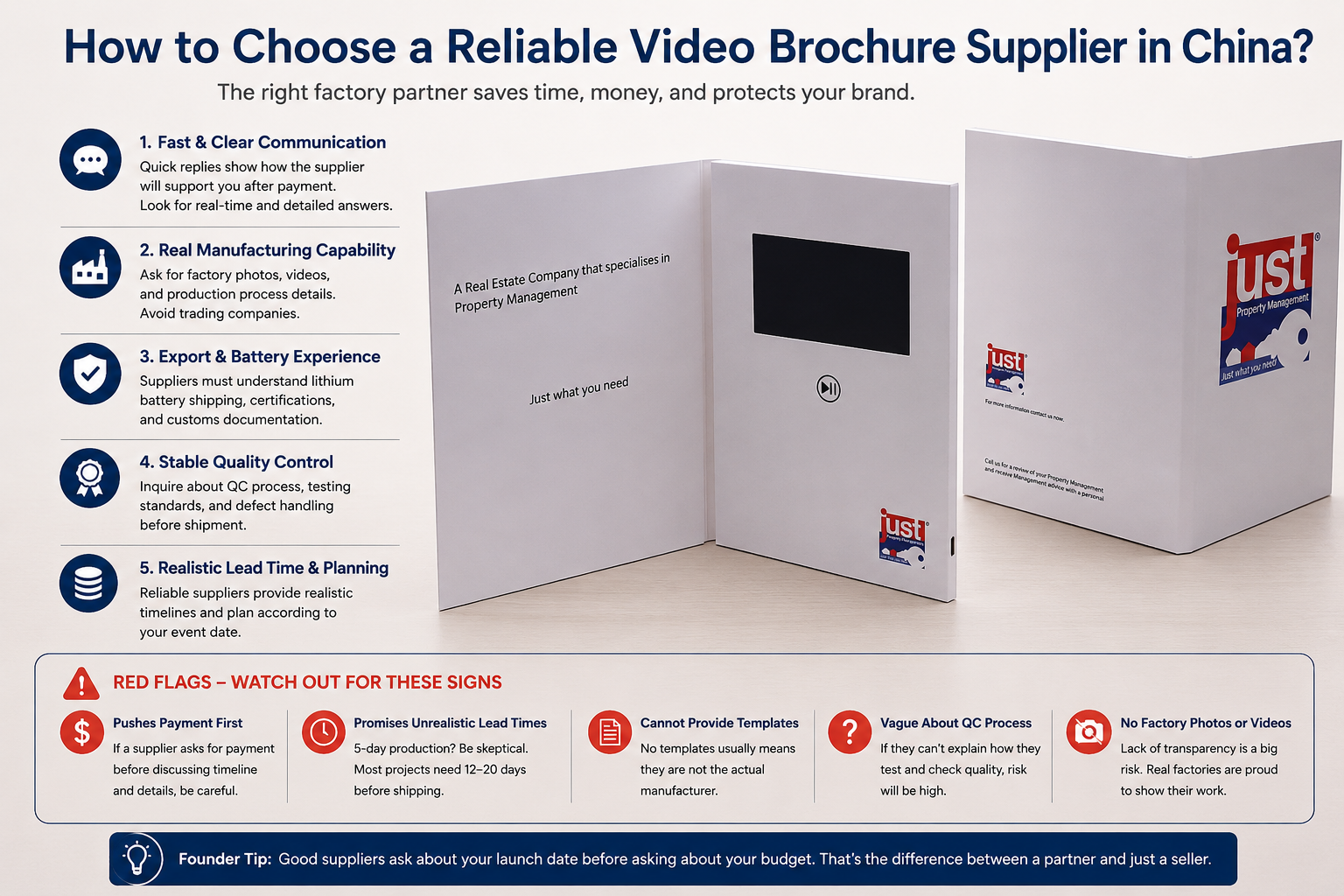
A reliable video brochure supplier should have strong communication, export experience, stable production capacity, and clear QC processes.
Warning Signs Of An Unreliable Supplier
| Warning Sign | Possible Problem |
|---|---|
| Supplier avoids discussing battery certifications | Limited export experience |
| Supplier pushes payment before discussing timeline | Weak production scheduling |
| Supplier cannot provide official templates | Possibly a trading company |
| Supplier promises unrealistic lead times immediately | Poor production planning |
| Supplier gives vague answers about QC | Weak quality control process |
| Supplier never asks about your deadline | Focused only on closing the order |
| Supplier avoids showing factory photos or videos | Limited manufacturing capability |
One red flag alone may not mean disaster.
But several together usually predict future delays.
In my experience, reliable factories usually ask about your launch date before they ask for payment.
That is often the difference between a supplier managing your project and a supplier simply taking your order.
Check Communication Speed First
Slow replies during quotation usually become worse after payment.
A responsive supplier should answer:
- technical questions
- artwork concerns
- shipping updates
- production issues
quickly and clearly.
Communication speed often predicts project reliability.
Conclusion
I have seen many video brochure projects miss important launch dates because buyers changed files too late or underestimated freight lead times.
Video brochures are not simple printed products. They combine electronics, printing, packaging, and international logistics.
The factories that deliver consistently are usually not the cheapest suppliers.
They are the suppliers that communicate clearly, prepare early, and understand how to manage production risks before delays happen.
For most video brochure orders from China, a realistic timeline is about four weeks from sample approval to delivery when using air freight.
Plan earlier than you think you need to.
That single decision prevents more delays than anything else.
-
Small layout changes can affect PCB positioning, foam inserts, and internal wiring alignment during assembly. ↩
-
Chinese New Year often disrupts production schedules for 2–4 weeks due to factory shutdowns and supplier backlog. ↩
-
Mid-production changes may require new tooling, revised foam structures, or updated internal component placement. ↩
-
Lithium battery documentation issues are one of the most common causes of customs and freight delays for video brochures. ↩