

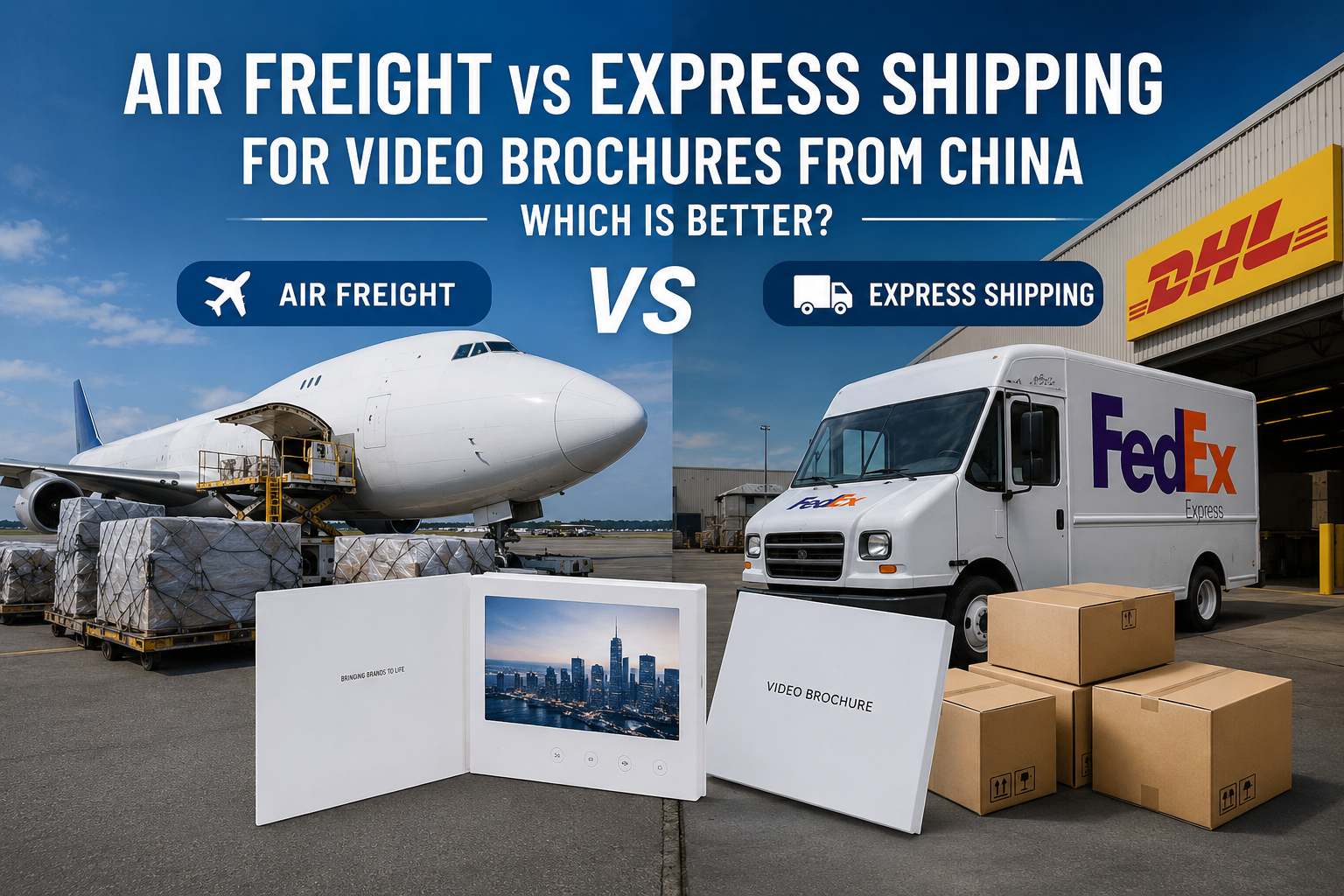
Many buyers choose the cheapest shipping option first. Then their video brochures arrive late, damaged, or stuck at customs because lithium battery products follow completely different logistics rules.
I’ve helped export thousands of video brochures from China. Here’s what actually works.
For video brochures from China, express shipping is usually better for small and urgent orders, while air freight becomes more economical for larger shipments. The best choice depends on quantity, timing, packaging size, and battery paperwork.
Most buyers think air freight is automatically faster. In real projects, that is often not true.
Why Are Video Brochures Expensive to Ship?
First-time buyers often compare video brochures to normal printed catalogs. They are not the same.
A video brochure is an electronic product with:
- a lithium battery
- an LCD screen
- speakers
- rigid packaging
- foam inserts
- magnetic closures
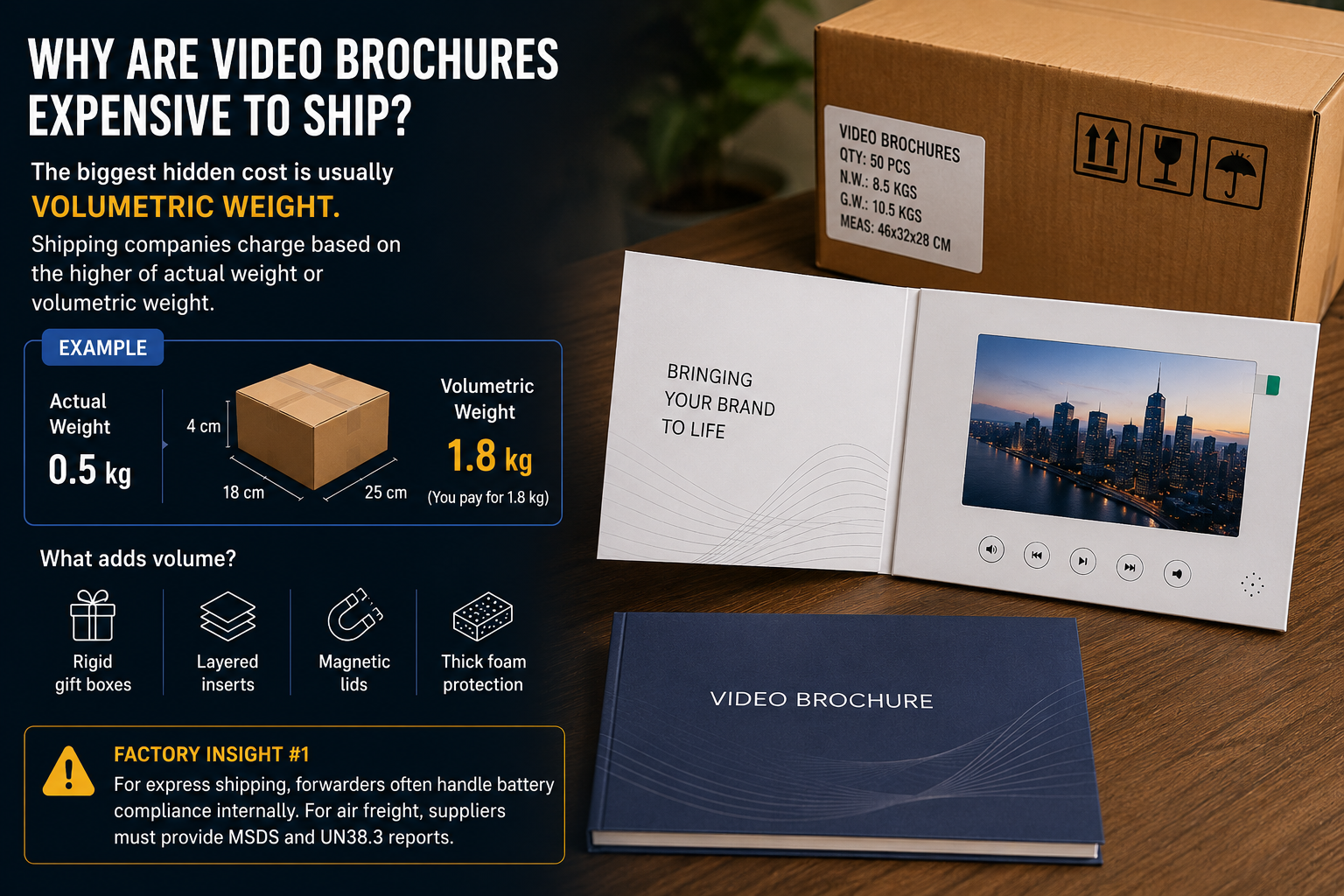
The biggest hidden cost is usually volumetric weight.
Shipping companies charge based on whichever is higher:
- actual weight
- volumetric weight
I see many buyers underestimate this until they receive the freight quote.
For example, a 7-inch magnetic video brochure may only weigh around 0.5 kg physically, but the carton dimensions increase the chargeable shipping weight significantly.
Luxury packaging makes this even worse.
Things like:
- rigid gift boxes
- layered inserts
- magnetic lids
- thick foam protection
all increase shipping volume very quickly.
Factory Insight #1: Battery Documents Change Everything
Most buyers do not realize shipping rules change completely once lithium batteries are involved.
For express shipping, forwarders often handle much of the battery compliance internally.
For air freight, suppliers usually need to provide:
- MSDS
- UN38.3 reports
- battery labels
- export declarations
| Shipping Method | Battery Paperwork | Usually Handled By |
|---|---|---|
| Express (DHL/FedEx) | Simpler | Courier or forwarder |
| Air Freight | MSDS + UN38.3 required | Supplier/exporter |
This is one reason many small orders go by express even when the shipping price is higher.
The paperwork barrier is lower.
When Should You Use Express Shipping?
Express shipping works best for:
- samples
- urgent campaigns
- PR kits
- trade show deliveries
- small production runs
Most video brochure factories mainly use DHL and FedEx because they are fast and operationally simple.
Typical delivery times are:
| Destination | Typical Delivery Time |
|---|---|
| USA | 5–10 days |
| Europe | 5–9 days |
| Australia | 6–10 days |
Weekends and customs delays can easily add 2–3 days. The "3–5 day" promise usually means ideal conditions only.
Why Express Shipping Is So Common
The biggest advantage is convenience.
Express couriers usually handle:
- pickup
- export clearance
- flight booking
- tracking
- local delivery
This makes small shipments easy.
Most buyers do not need to coordinate:
- freight forwarders
- brokers
- warehouse appointments
- airport cargo handling
But Costs Rise Quickly
Once quantities increase beyond 50–100 units, express shipping becomes expensive very fast.
Especially for:
- 7-inch screens
- magnetic gift boxes
- foam inserts
- multilayer packaging
I often see first-time buyers surprised that shipping costs can approach the product cost itself.
Factory Insight #2: Express Is Usually the Default
Many people assume air freight is the default for factory exports.
In our industry, it usually is not.
Most video brochure shipments actually move through express couriers because:
- quantities are relatively small
- buyers want simplicity
- battery paperwork is easier
- delivery is faster
Air freight usually becomes practical only when shipments become much larger.
When Does Air Freight Become Cheaper Than DHL or FedEx?
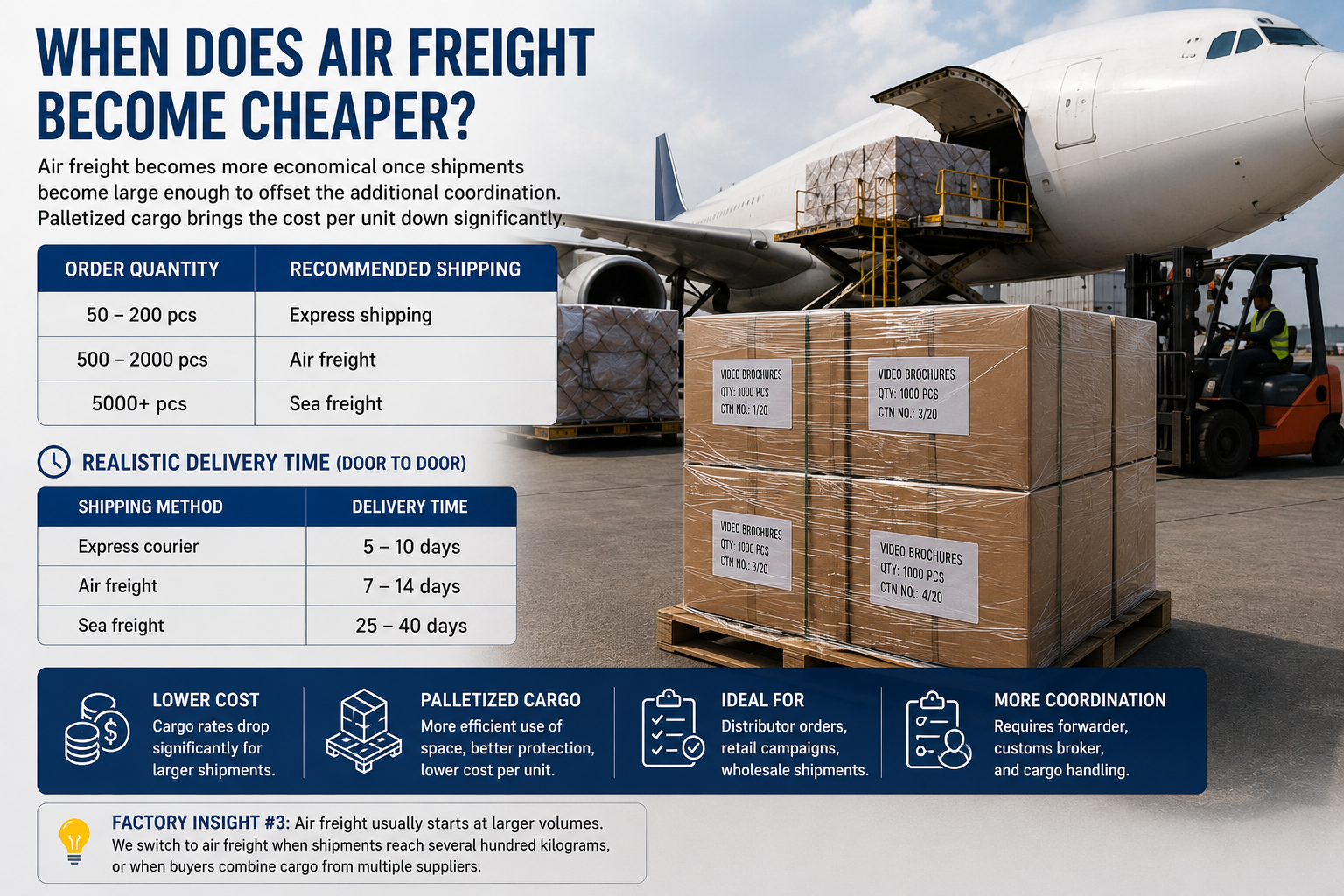
Air freight becomes more economical once shipments become large enough to offset the additional coordination.
In our factory, we usually see patterns like this:
| Order Quantity | Recommended Shipping |
|---|---|
| 50–200 pcs | Express shipping |
| 500–2000 pcs | Air freight |
| 5000+ pcs | Sea freight |
This is not a strict rule, but it reflects real export behavior.
Why Air Freight Can Reduce Costs
Once cartons move together on pallets, cargo pricing becomes much more efficient.
This matters for:
- distributor orders
- retail campaigns
- corporate gifting projects
- wholesale shipments
Large shipments often become significantly cheaper through air cargo compared to DHL or FedEx.
Especially when multiple cartons ship together.
But Air Freight Is Not Always Faster
Most buyers misunderstand this part.
Air freight still requires:
- cargo booking
- airport handling
- customs clearance
- local trucking
- warehouse processing
So real timelines often look like this:
| Shipping Method | Realistic Delivery Time |
|---|---|
| Express courier | 5–10 days |
| Air freight | 7–14 days |
Express couriers usually move faster because their systems are more streamlined.
Factory Insight #3: Cheap Cartons Cause Expensive Problems
Most factories focus heavily on product pricing but not enough on export packaging.
I honestly think poor cartons ruin more video brochure projects than screen problems do.
Video brochures are paper-based products. One hard drop can permanently deform the cover.
We normally use:
- EPE foam
- edge protectors
- reinforced export cartons
especially for magnetic boxes and larger screens.
Most shipping complaints are not actually electronics failures.
They are packaging failures.
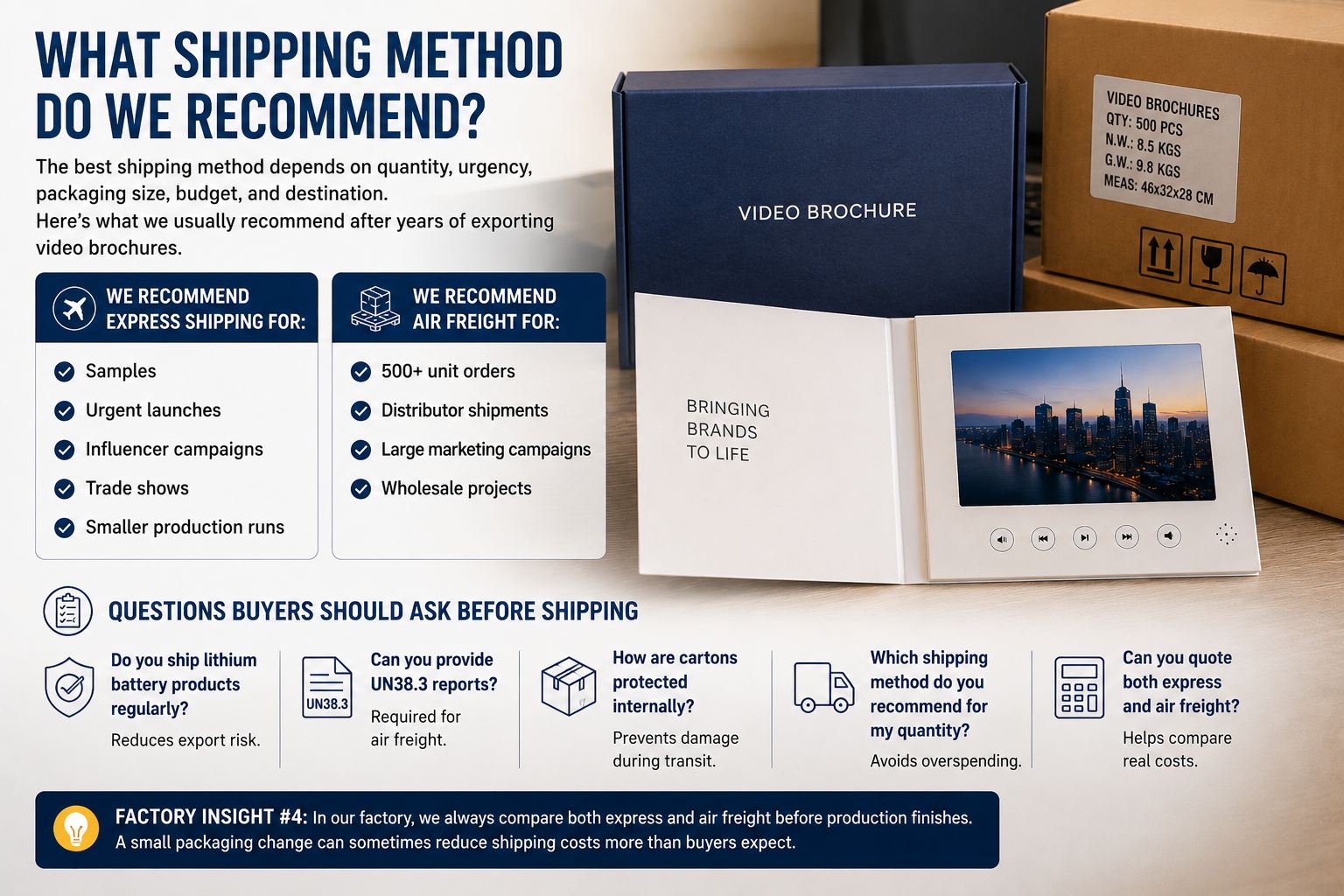
What Shipping Method Do We Usually Recommend?
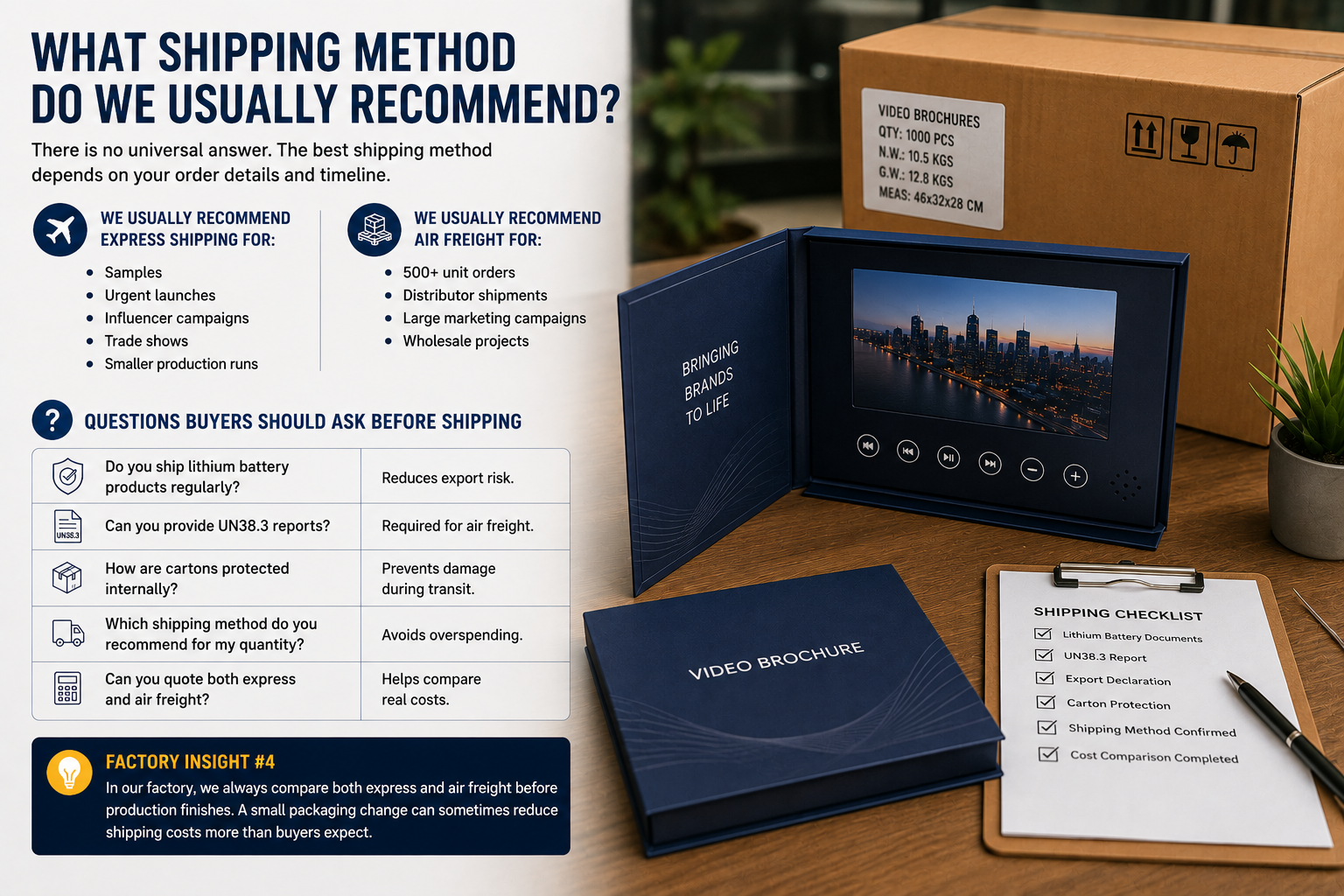
There is no universal answer.
The best shipping method depends on:
- quantity
- urgency
- packaging size
- budget
- destination country
But after years of exporting video brochures, I do see clear patterns.
We Usually Recommend Express Shipping For:
- samples
- urgent launches
- influencer campaigns
- trade shows
- smaller production runs
We Usually Recommend Air Freight For:
- 500+ unit orders
- distributor shipments
- large marketing campaigns
- wholesale projects
Questions Buyers Should Ask Before Shipping
| Question | Why It Matters |
|---|---|
| Do you ship lithium battery products regularly? | Reduces export risk |
| Can you provide UN38.3 reports? | Required for air freight |
| How are cartons protected internally? | Prevents damage |
| Which shipping method do you recommend for my quantity? | Avoids overspending |
| Can you quote both express and air freight? | Helps compare real costs |
My advice is simple.
Use express shipping for speed and simplicity.
Use air freight once your order volume becomes large enough to justify the extra coordination.
And never ignore battery paperwork and packaging protection.
Footnotes
-
UN38.3 is a lithium battery transportation safety standard required for most international air cargo shipments containing lithium batteries.
-
Volumetric weight is calculated using package dimensions instead of actual weight. Large rigid gift boxes often increase chargeable freight costs significantly.
-
EPE foam refers to Expanded Polyethylene foam commonly used to protect electronics and paper-based packaging during export shipping.
-
Delivery timelines vary depending on customs inspections, flight schedules, destination country regulations, and seasonal congestion periods.
Conclusion
Express shipping is better for urgent small orders, while air freight becomes more economical for larger video brochure shipments. The right choice depends on quantity, timing, packaging size, and lithium battery shipping requirements.